

Phenomenon of the Nomadic Dwelling
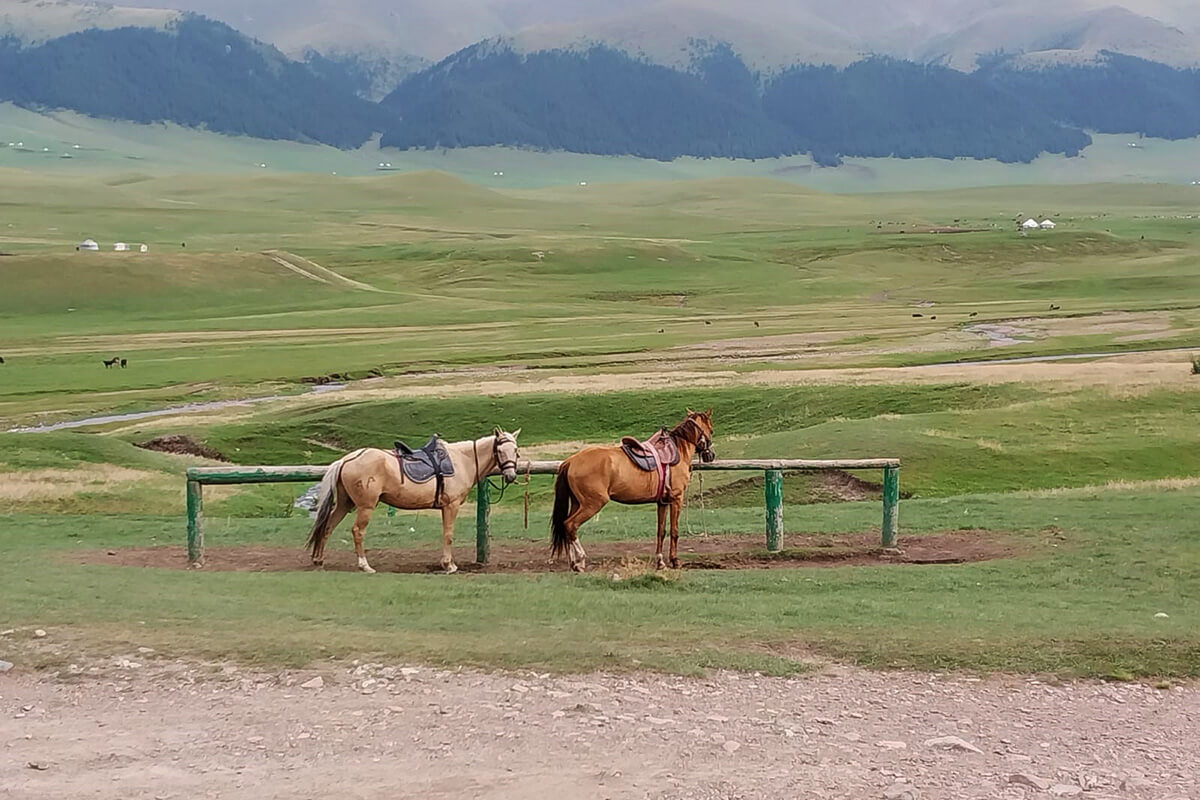
The yurt is a unique, portable dwelling that has become the ultimate symbol of the peoples of the Great Steppe. Originating in deep antiquity as a perfect response to the challenges of a nomadic lifestyle, it harmoniously combines a simple design with exceptional practical benefits.
This mobile home possesses remarkable characteristics: it is easily assembled, disassembled, and transported. The yurt’s structure is perfectly adapted to the harsh continental climate of Eurasia. Its "breathing" walls provide reliable protection against piercing steppe winds and heavy downpours, retain heat during winter frosts, and cool down quickly on hot summer nights.
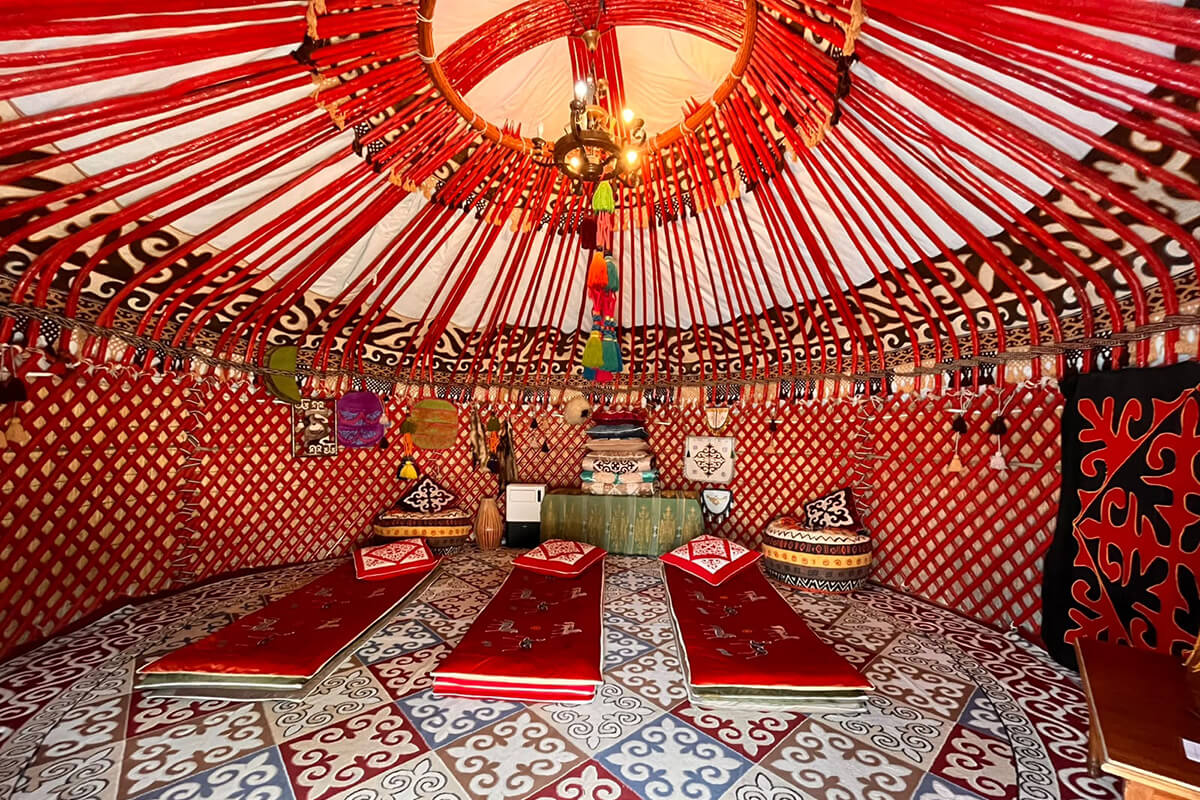
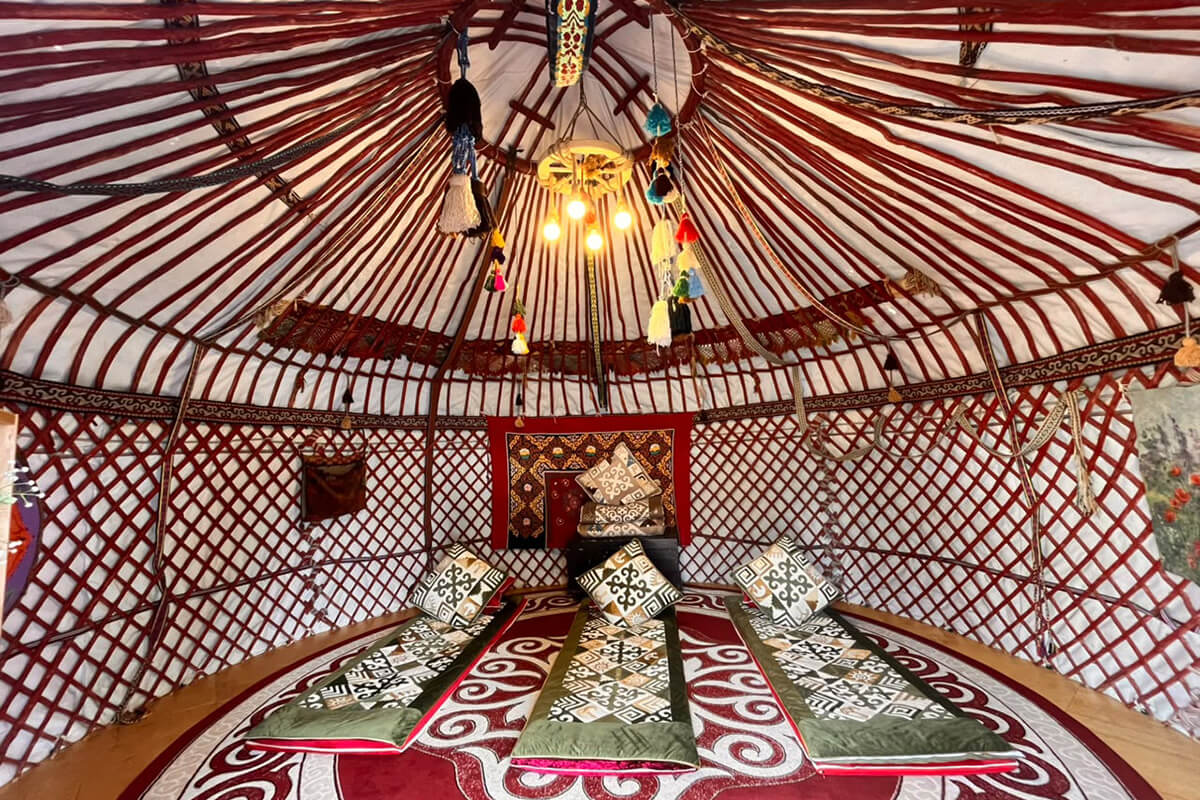
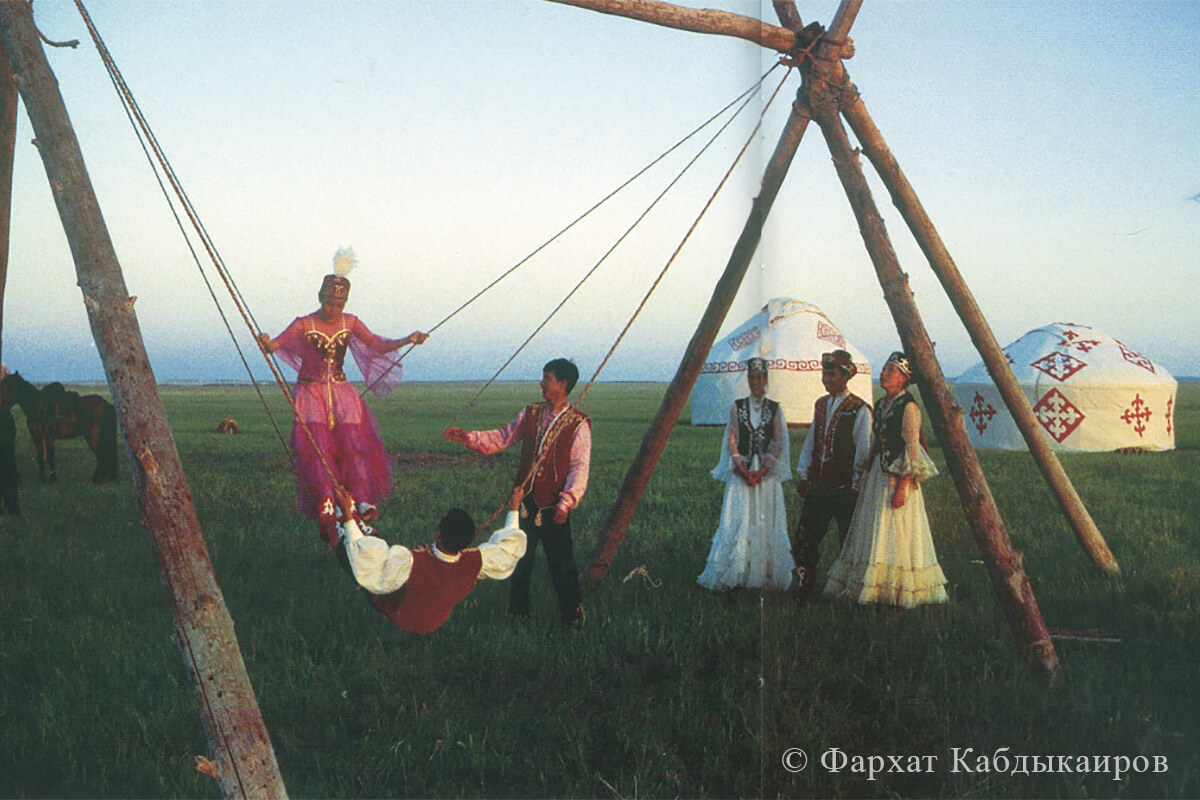
The yurt embodies features of both material and deep spiritual culture. Its interior, rich in traditional ornaments, reflects the centuries-old heritage and aesthetics of the Kazakh people.
Today, in the era of urbanization, the yurt has not lost its relevance. It remains indispensable in the daily lives of shepherds on seasonal pastures, serves as the main attribute of Nauryz celebrations, and is experiencing a revival in eco- and ethno-tourism. The desire of modern people to spend time in a yurt is not just a pursuit of comfort and aesthetics, but also a living "call of the ancestors," allowing them to find true unity with nature.
History and Evolution of the Yurt
The exact time of the yurt's appearance remains unknown; it is an invention of deep antiquity. According to archaeological and ethnographic data, a prototype of the yurt was already actively used by nomads during the Late Bronze Age (12th–9th centuries BC).
Origin of the Term
What is commonly referred to as a "yurt" in the modern world (derived from the Turkic word zhurt, meaning a place of residence or a nomad's campsite) was initially established in international vocabulary thanks to European researchers. The Kazakhs themselves have anciently called their home kiiz üi, which literally translates to "felt house" (kiiz — felt, üi — house).
From Andronovo Structures to Ideal Geometry
The answer to the origins of the kiiz üi was provided by large-scale excavations in ancient Andronovo settlements (Atasu, Buguly, Chaglinka), where archaeologists discovered the remains of circular frame structures made of wooden poles. These are recognized as the direct prototype of the yurt.
The evolution of the design largely depended on the harsh climate of Eurasia. For centuries, strong steppe winds influenced the aerodynamic shape and low height of the structure. As a result of long historical selection, the yurt acquired a time-tested, perfect geometric form, where a clever engineering solution merged seamlessly with the properties of natural materials.
Evidence of Antiquity and Art
The cultural footprint of this mobile dwelling is recorded in numerous historical monuments:
- Ancient Artifacts: The first depictions of the parts of a folding house were discovered in Kerch, while ancient ceramic figurines in the shape of mobile wagons were found in Northern China.
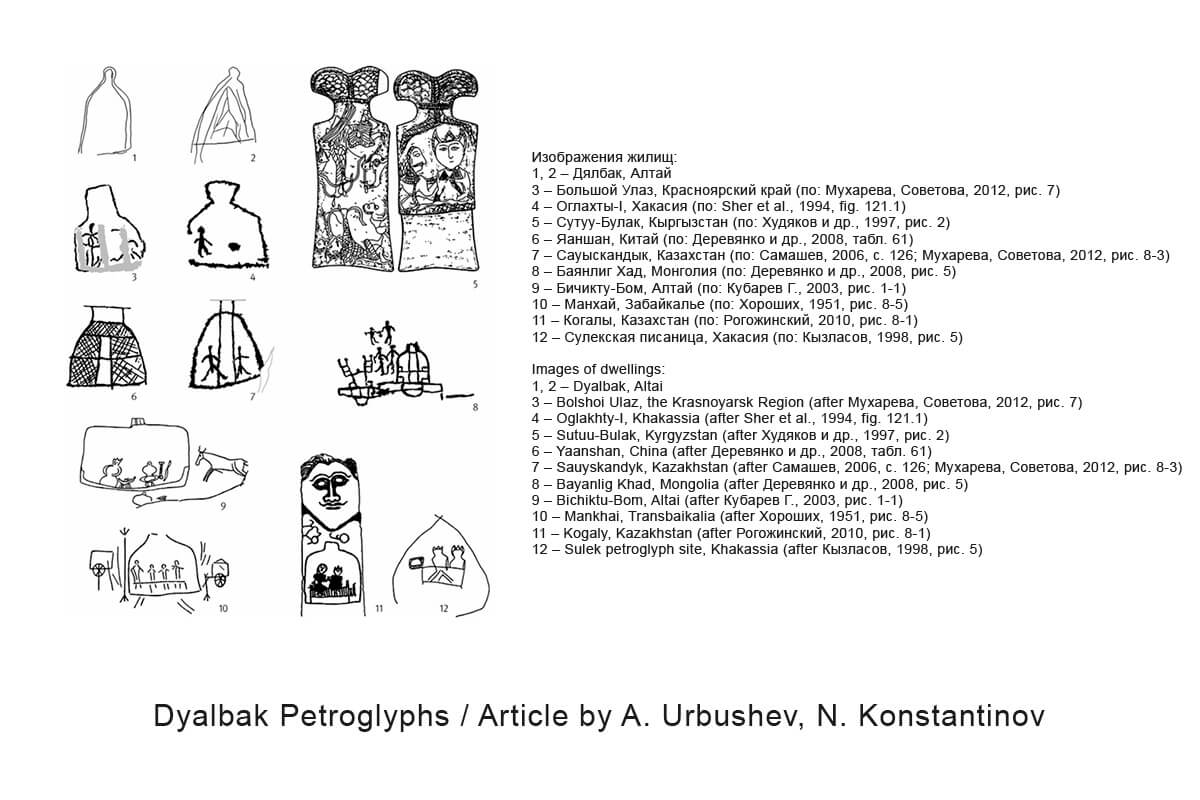
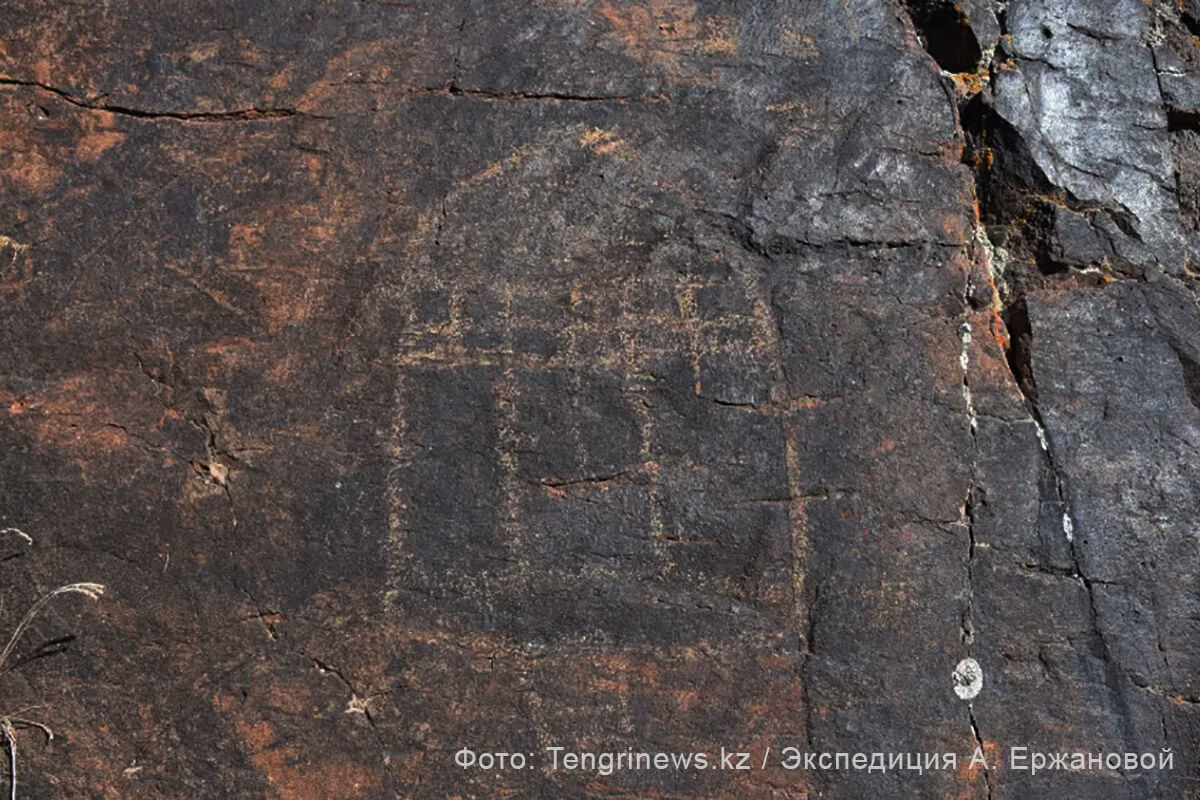
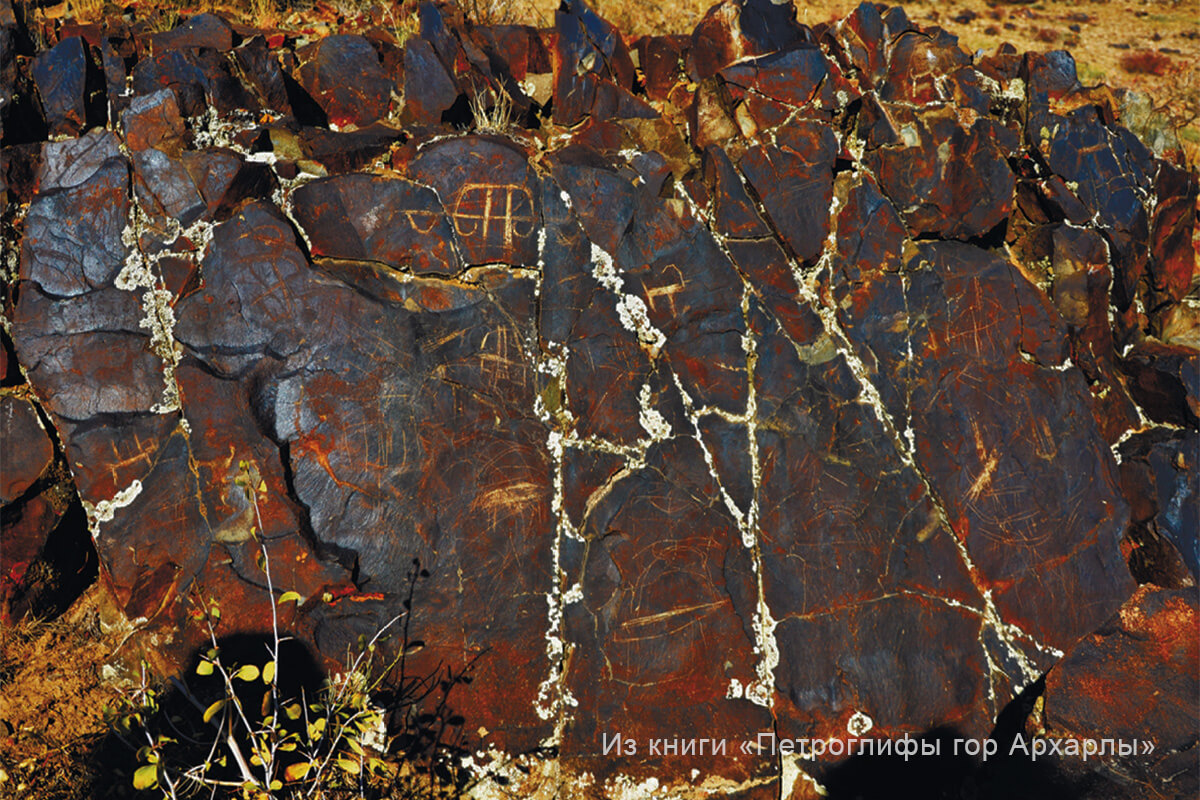
- Petroglyphs of Kazakhstan: Crucial evidence comes from the tent-type rock carvings found in the Katon-Karagay district of the East Kazakhstan region. Even in these drawings, the interior space is already clearly divided into male and female halves.
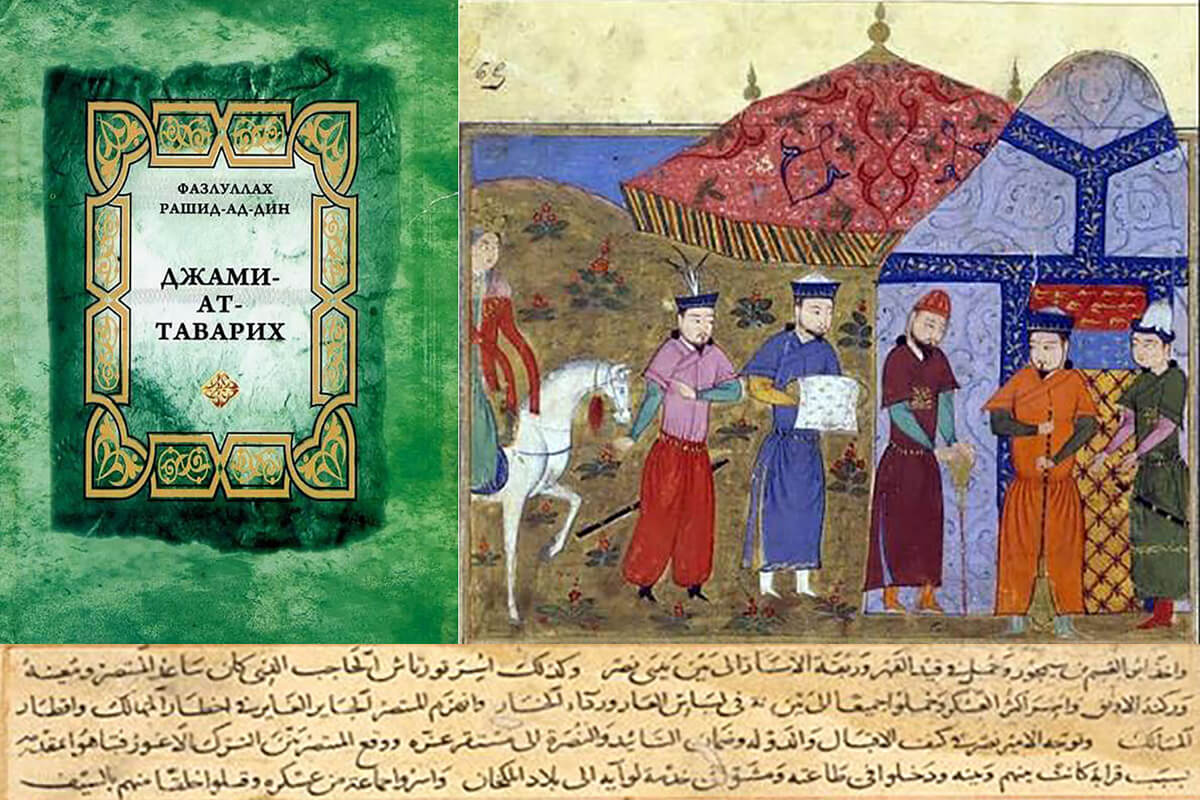
- Artistic Chronicle: Paintings by early artists and medieval miniatures from China, Central Asia, and Turkey clearly display the circular outlines of the yurt and its core elements: the folding lattice framework (kerege), the sloping roof poles (uyq), and the circular rim crowning the dome (shañyraq), which served as a smoke exhaust.
Steppe Home Hierarchy
The owner’s social status directly determined the size and purpose of the kiiz üi. Depending on wealth and function, yurts were divided into several types:
- Ceremonial and Festive Yurts (otau üi): Luxurious wedding yurts for newlyweds or for receiving honored guests. The wealthiest in terms of decoration was the Khan’s yurt; it possessed a massive framework of 10 folding sections (qanat) and belonged exclusively to the nobility.
- Ordinary Yurts of the Common People: The most widespread type across the territory of Kazakhstan was the six-section yurt (consisting of 6 qanats).
The number of supporting sections strictly determined the number of roof poles (uyq) that held up the dome, maintaining the perfect shape of the steppe home.
Travelers' Accounts
The structural elegance of the nomadic home amazed researchers for centuries. At the beginning of the 16th century, the famous historian of the East, Fazlallah ibn Ruzbihan, wrote that he was sincerely astonished by the structure of these wagon-houses with neat windows and felt curtains, which seemed "erected as if in mid-air," adding that his mind was struck by their "beauty, craftsmanship, and elegance."
Yurt Structure: The Wooden Framework
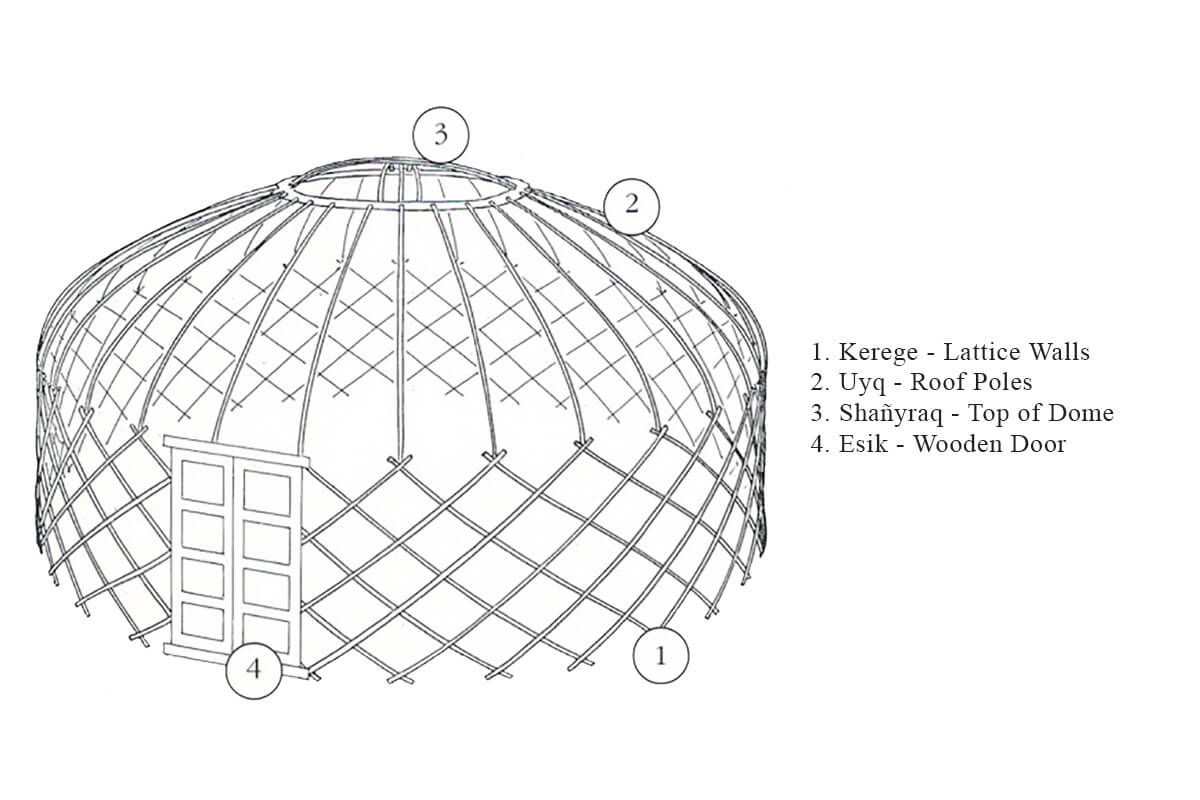
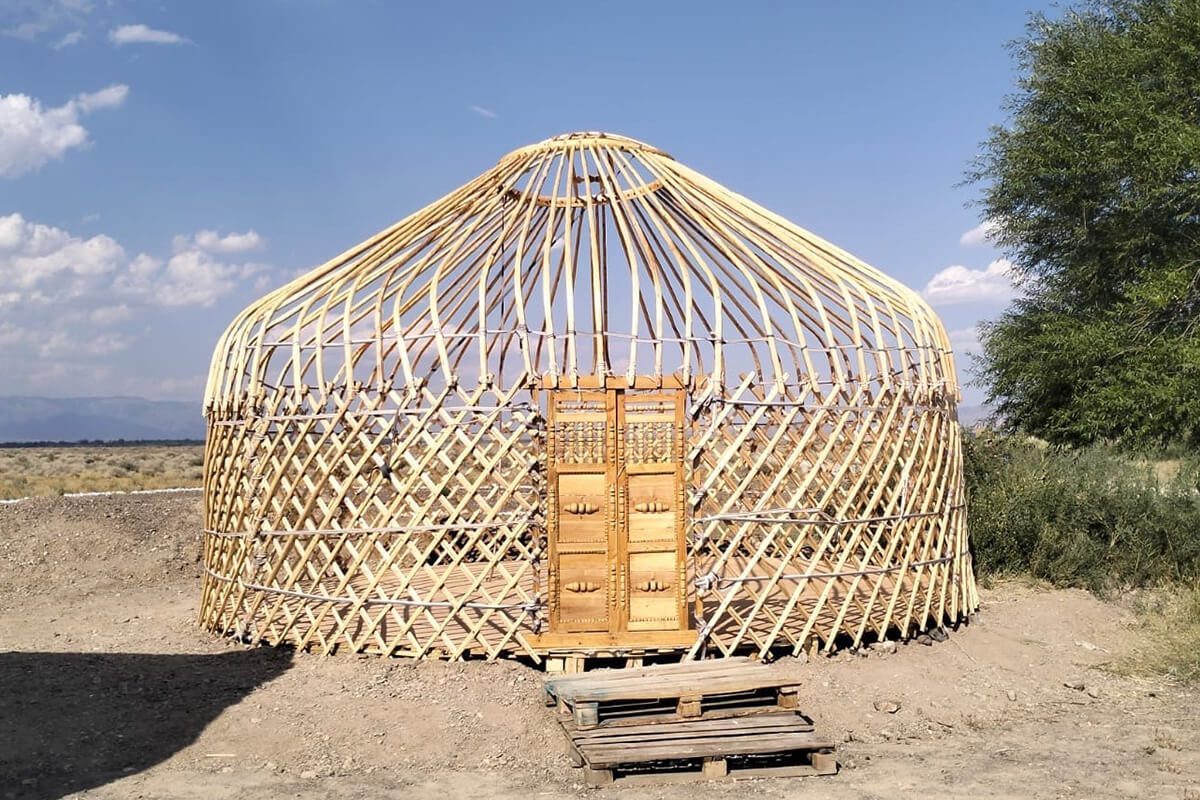
The design of the kiiz üi (felt house) is a masterpiece of steppe engineering. This mobile dwelling possesses remarkable strength, earthquake resistance, and the ability to withstand immense wind and snow loads. The secret lies in its unique wooden framework, which is assembled without a single nail and consists of four main interconnected elements.
1. Kerege — The Lattice Foundation
Kerege refers to the expandable lattice walls of the yurt, which function as the load-bearing foundation holding the entire weight of the upper structure.
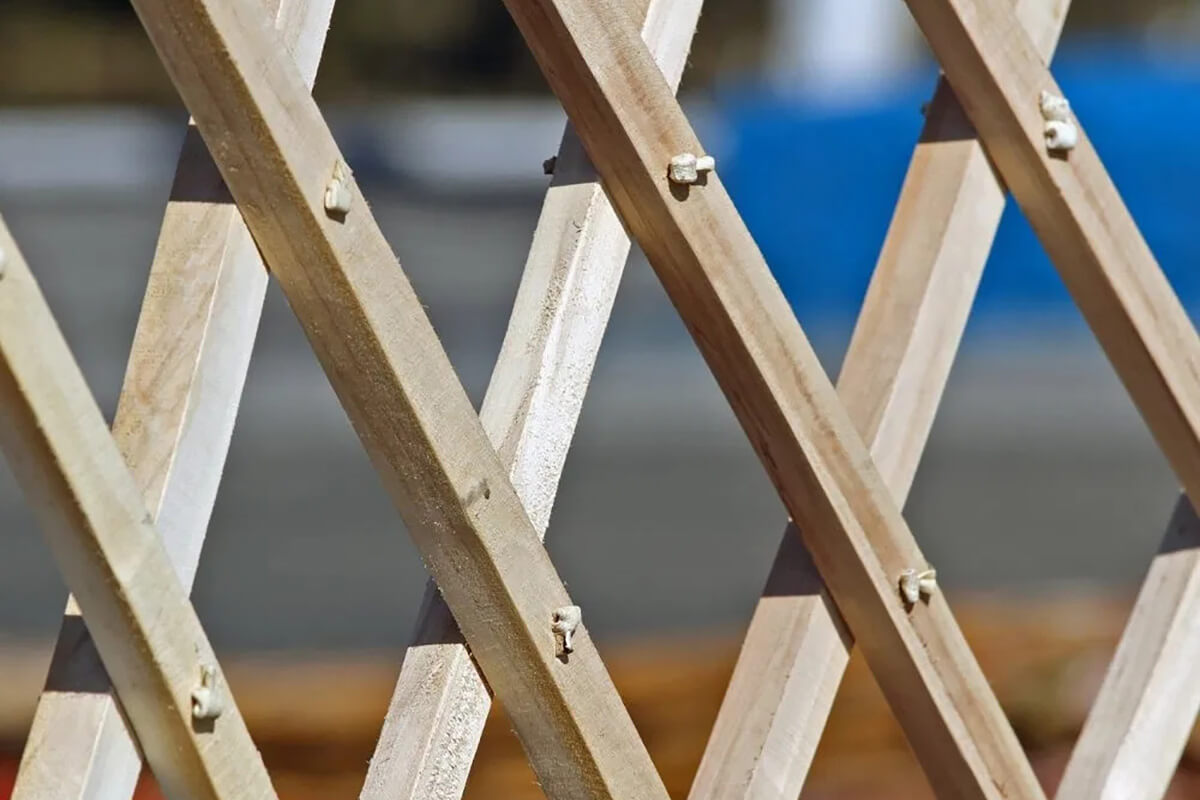
- Design: The walls are assembled from separate sections called qanat (literally — "wing"). Each "wing" consists of thin wooden slats interconnected diagonally by leather straps, allowing the lattice to easily fold and unfold like an accordion.
- Dimensions: Once assembled and installed, the height of the kerege walls can reach up to 3.5 meters.
2. Uyq — The Roof Poles
Uyq refers to the long, sloping poles that connect the walls (kerege) with the upper dome ring, forming the streamlined roof of the home.
- Design: Traditionally, uyq poles are crafted from flexible yet strong willow or birch wood. Craftsmen specially steam and bend the lower part of the pole. This curve gives the Kazakh yurt its famous hemispherical shape and high resistance to weight loads.
- Dimensions: The length of a single pole can reach up to 3 meters. The upper end of the uyq is sharpened into a four-sided shape (about 20 cm long) to fit precisely into the slots of the dome ring.
3. Shañyraq — The Heart of the Dome
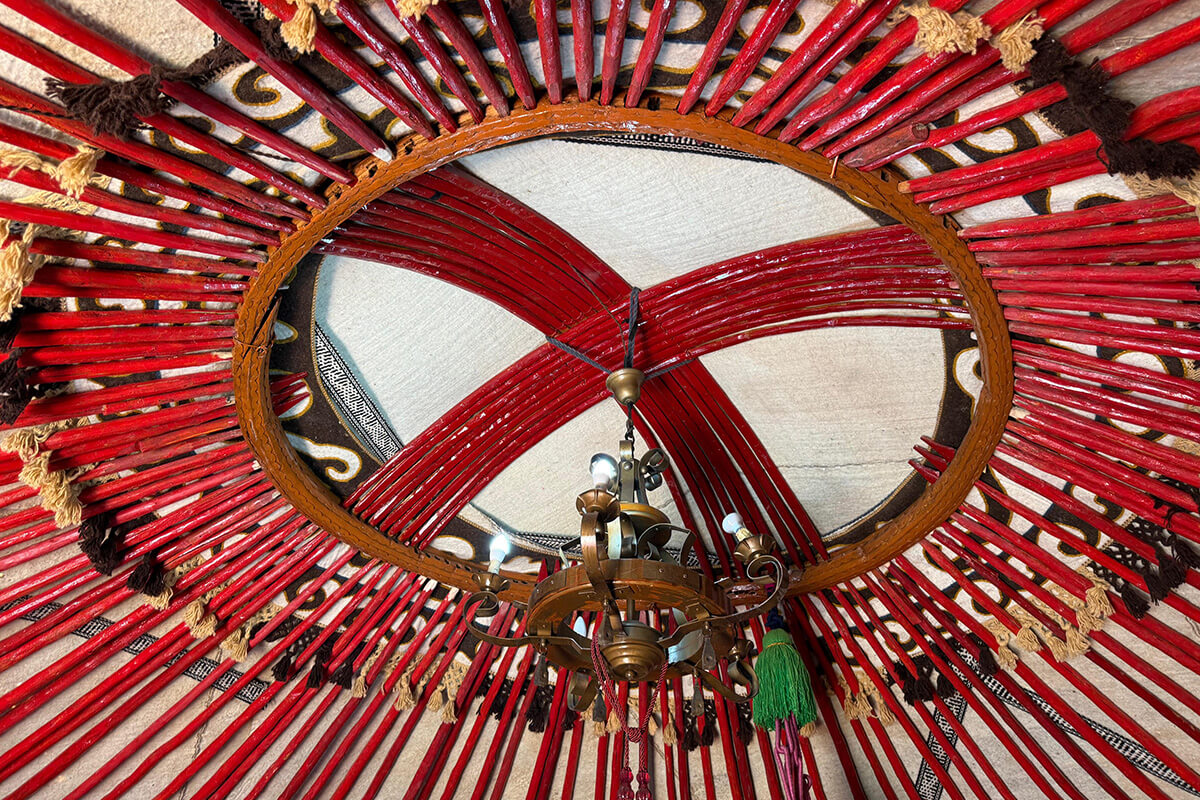
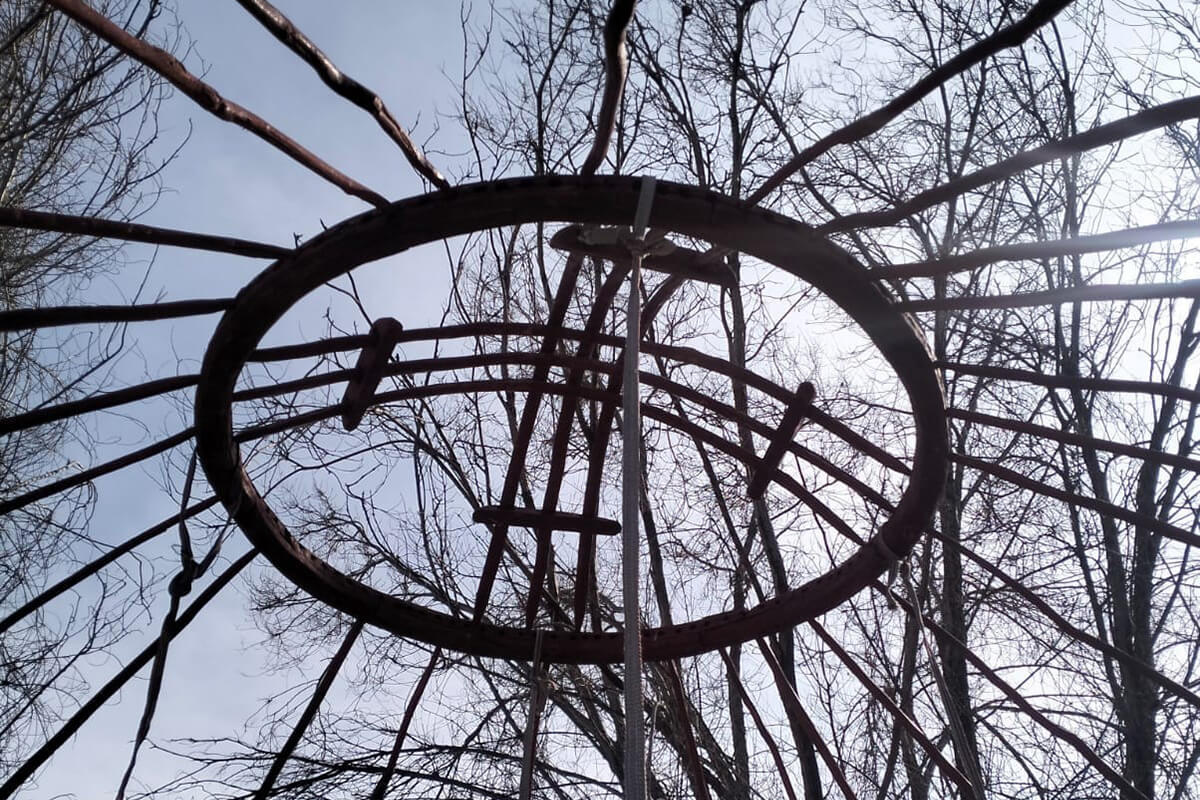
Shañyraq is the crowning circular rim of the yurt, serving as the ultimate symbol of home, hearth, and the continuation of the family line. It acts simultaneously as a window for illumination and an opening for smoke exhaust.
- Design: The rim is crafted from solid-bent birch with a thickness of 12–15 cm, and its diameter starts from 1.5 meters. Through-square holes are carved along the outer circumference of the rim, into which the four-sided tips of the roof poles (uyq) are inserted during assembly.
- Küldireuish: The center of the shañyraq is protected by a cross-grid of wooden arches bent into a hemisphere — the küldireuish (usually three bars along each axis). They provide rigidity to the dome, protect the structure from deformation, and hold up the top felt flap (tündik), preventing it from sagging inward.
4. Esik — The Wooden Door
The double-winged door (esik) is one of the most important and artistically decorated parts of the steppe home.
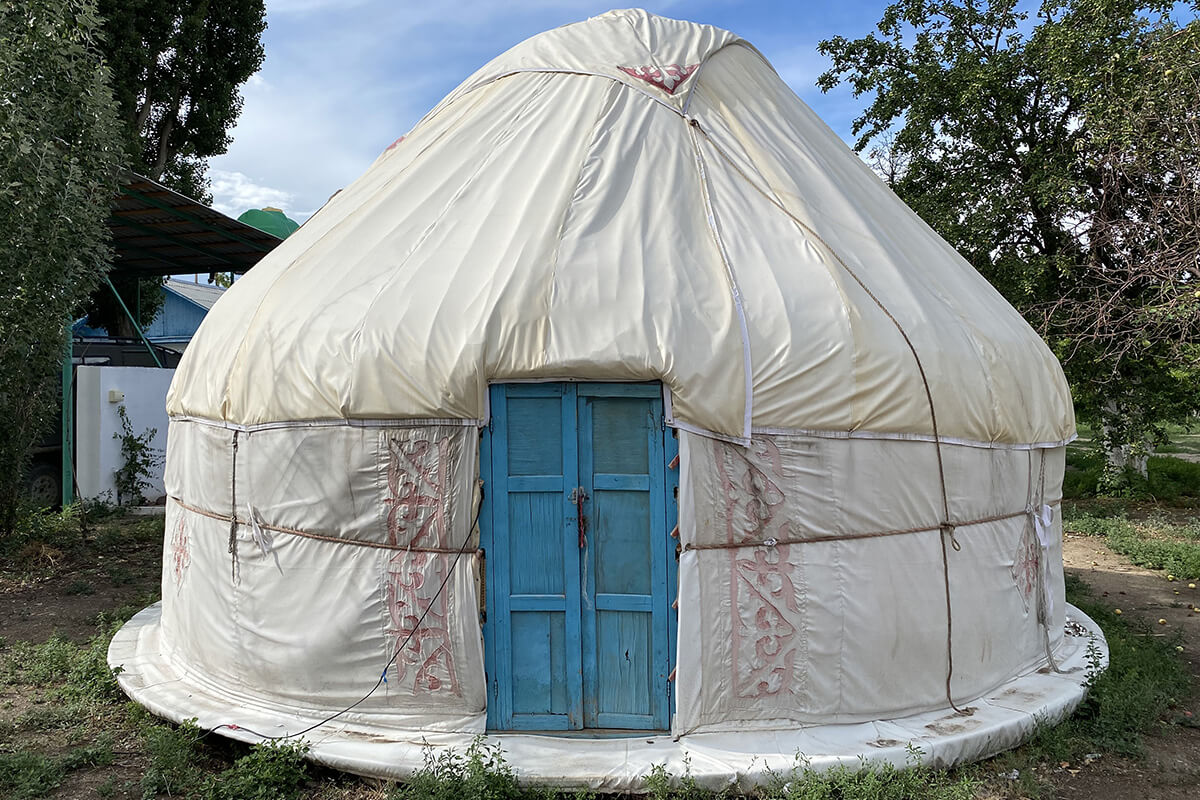
- Design: The door structure consists of three main elements: a massive wooden frame, two carved wooden door wings (often adorned with traditional paintings), and an outer felt curtain with a patterned mat sewn to it.
- The Curtain: The curtain is decorated with complex national appliques or ornaments and serves as a reliable barrier, protecting the interior space from drafts and cold.
Yurt Structure: Felt Covering
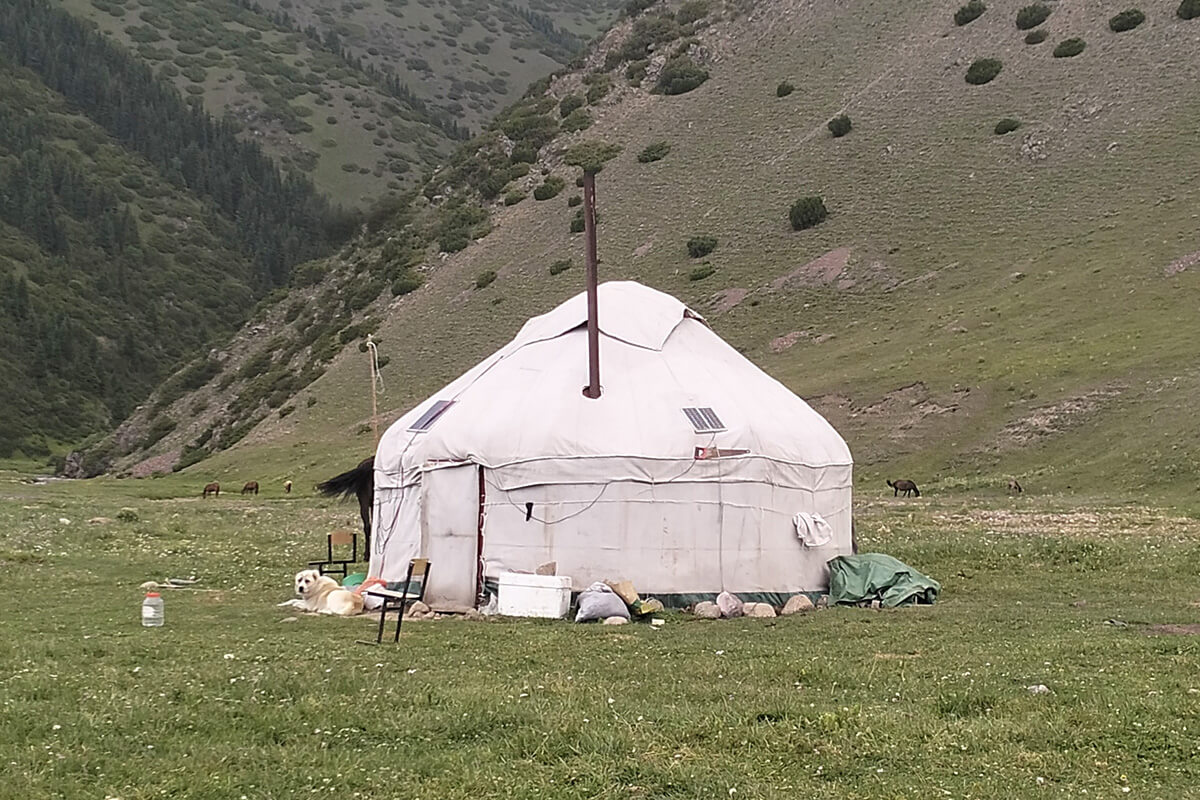
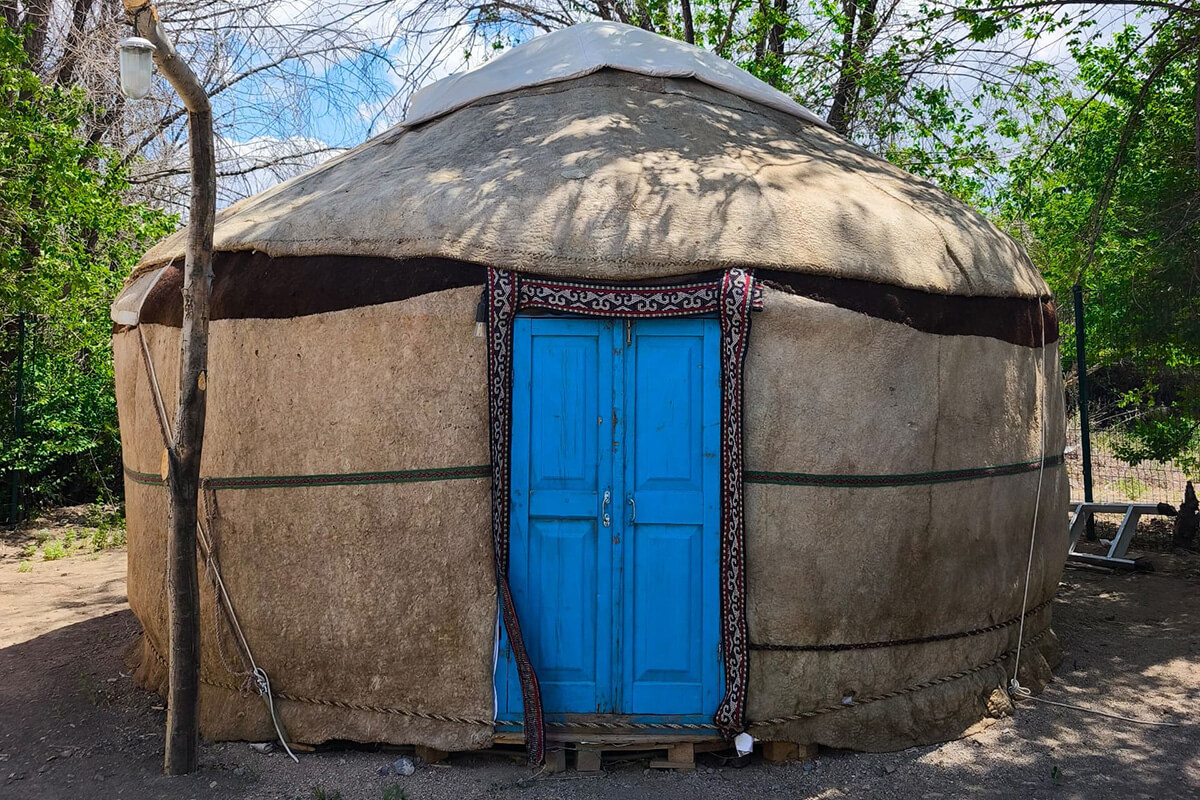
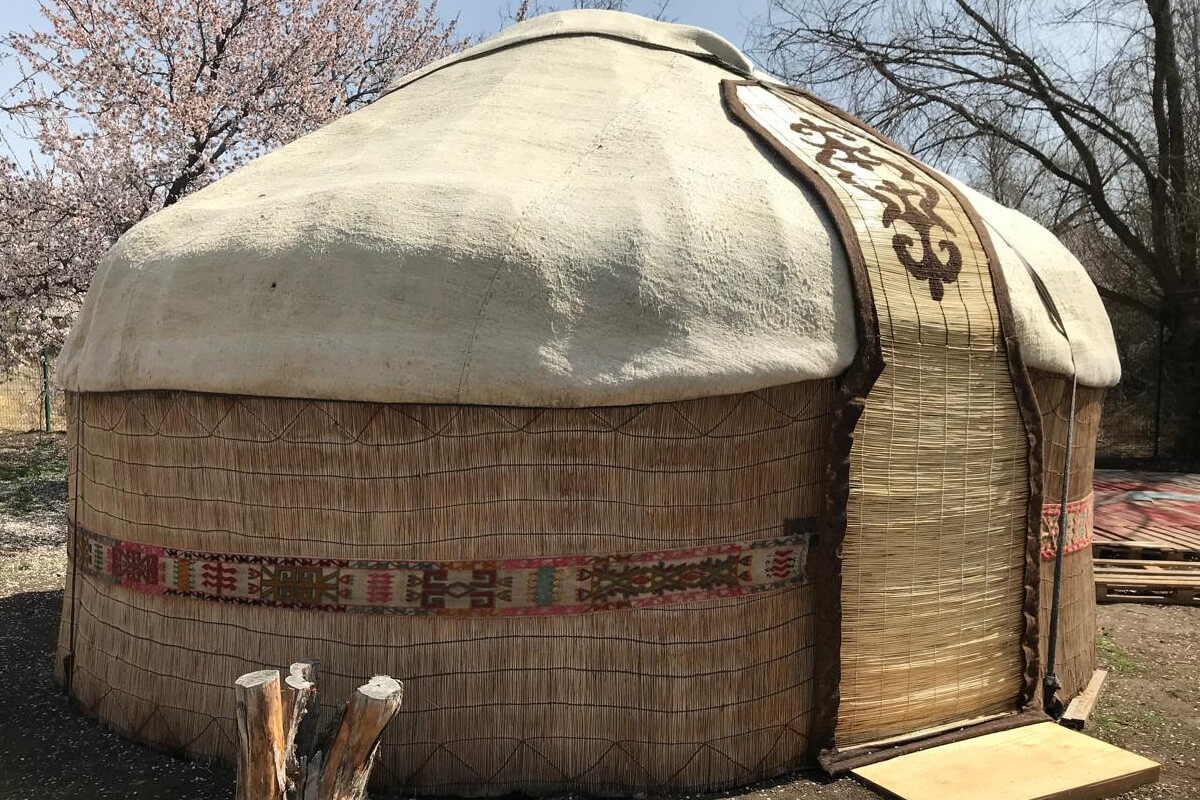
The wooden frame of the yurt is completely covered from the outside with a dense felt cladding (kiiz), which is handmade from sheep's wool. These felt elements are precisely shaped and perform the functions of a roof, waterproofing, and insulation: they retain heat in the winter and keep the interior cool during the summer.
1. Tuyyrlyq — The Lower Roof Belt
Tuyyrlyq refers to the massive, trapezoid-shaped felt sheets. They are designed to protect the walls, covering the entire perimeter of the lattice foundation (kerege) as well as the lower portion of the roof poles (uyq).
2. Üzik — The Upper Dome Covering
Üzik refers to the felt sheets that are layered over the tuyyrlyq, covering the remaining upper section of the roof poles. The üzik sheets are pulled tight with ropes, tied to the base of the door frame, and firmly secured to the yurt's cross belt with wide, patterned ribbons (bau-basqür). The lower edge of the üzik is styled into a dödege — a decorative ornamented band. This elegant border is cut from contrasting colors of felt and sewn along the entire edge of the dome, serving not only an aesthetic function but also protecting the joints from rainwater leakage.
3. Tündik — The Top Flap
Tündik is a square piece of felt that covers the very highest point of the yurt — the smoke-and-light rim (shañyraq). During the day or while the hearth is burning, the tündik is pulled back using special ropes for ventilation, illumination, and to allow smoke to draw out from the central fire. At night or during bad weather, it is tightly shut, completely sealing the home.
4. Shi — The Reed Screen
Before pulling on the tuyyrlyq felt sheets, the lattice walls (kerege) are wrapped from the outside with a shi — a special mat woven from steppe reeds (cheegrass). It protects the felt from rubbing against the wood, blocks dust from entering, and on hot summer days (when the felt is lifted for airing), ensures free air circulation, acting much like window blinds.
5. Kiiz Esik — The Felt Curtain
While the carved wooden double-winged door might sometimes be absent under rugged nomadic campaign conditions, the outer felt covering (kiiz esik) is an indispensable and mandatory attribute of any yurt. To prevent cold air from entering the dwelling, this thick curtain is additionally lined with a patterned mat on the inside and decorated with complex national ornaments on the outside using applique techniques.
Yurt Interior Space: Zoning and Decoration
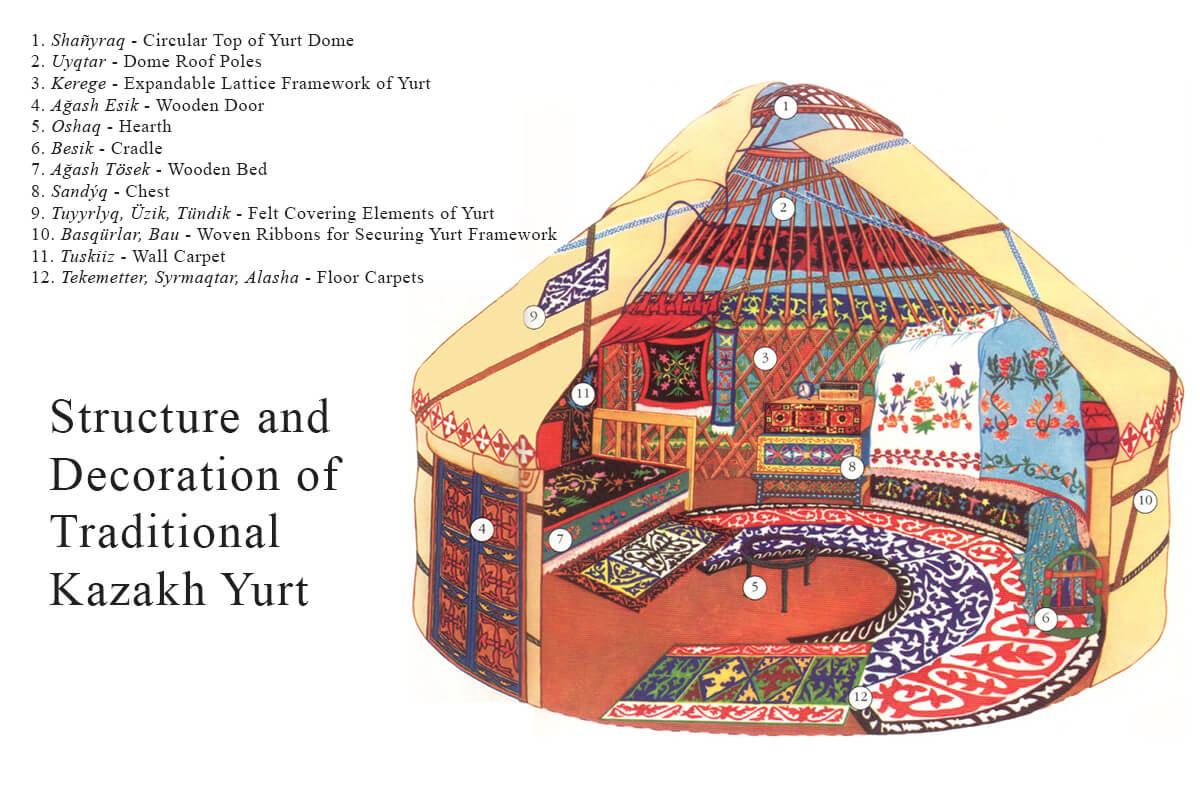
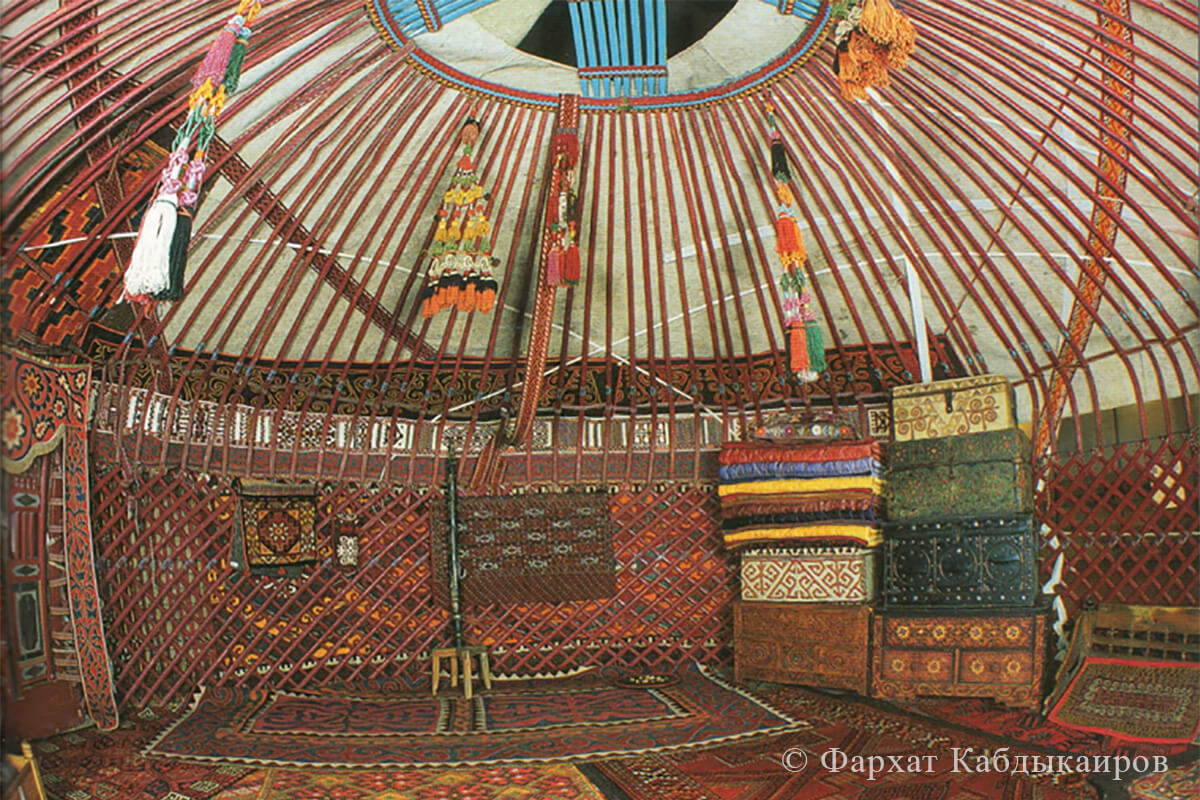
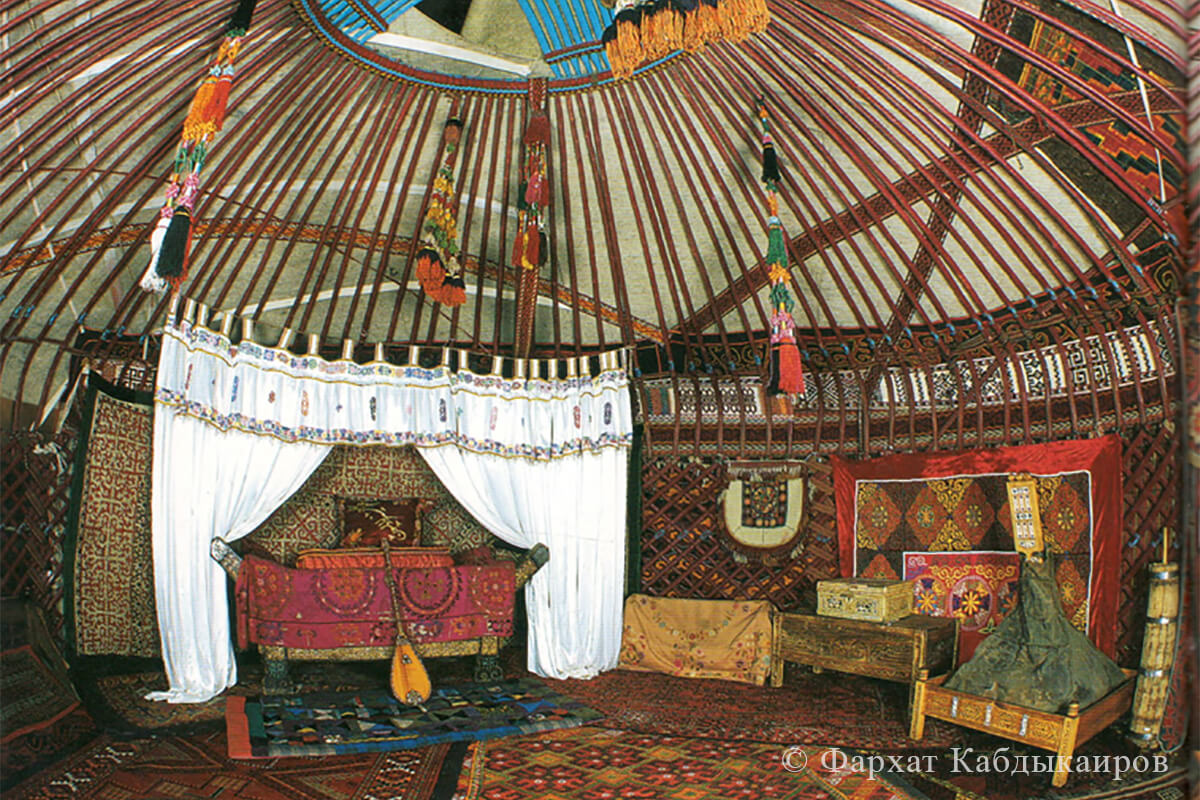
The circular shape of the kiiz üi (felt house) and its limited floor area dictate a strict organization of the interior. To keep the home spacious, belongings are arranged in a circle along the walls, placed on the floor, or suspended from the wooden framework. While there are no solid partitions inside the yurt, it is divided into clear, meaningful zones, each filled with pieces of traditional folk arts and crafts.
1. Oshaq — The Sacred Center
At the very center of the yurt lies the hearth (oshaq). This is the cooking area, the main source of heat and light, and a place revered as the heart of the home.
2. Tör — The Place of Honor
Opposite the entrance, directly behind the hearth, lies the tör — the most honorable and beautifully decorated area in the house, where respected guests and elders are seated.
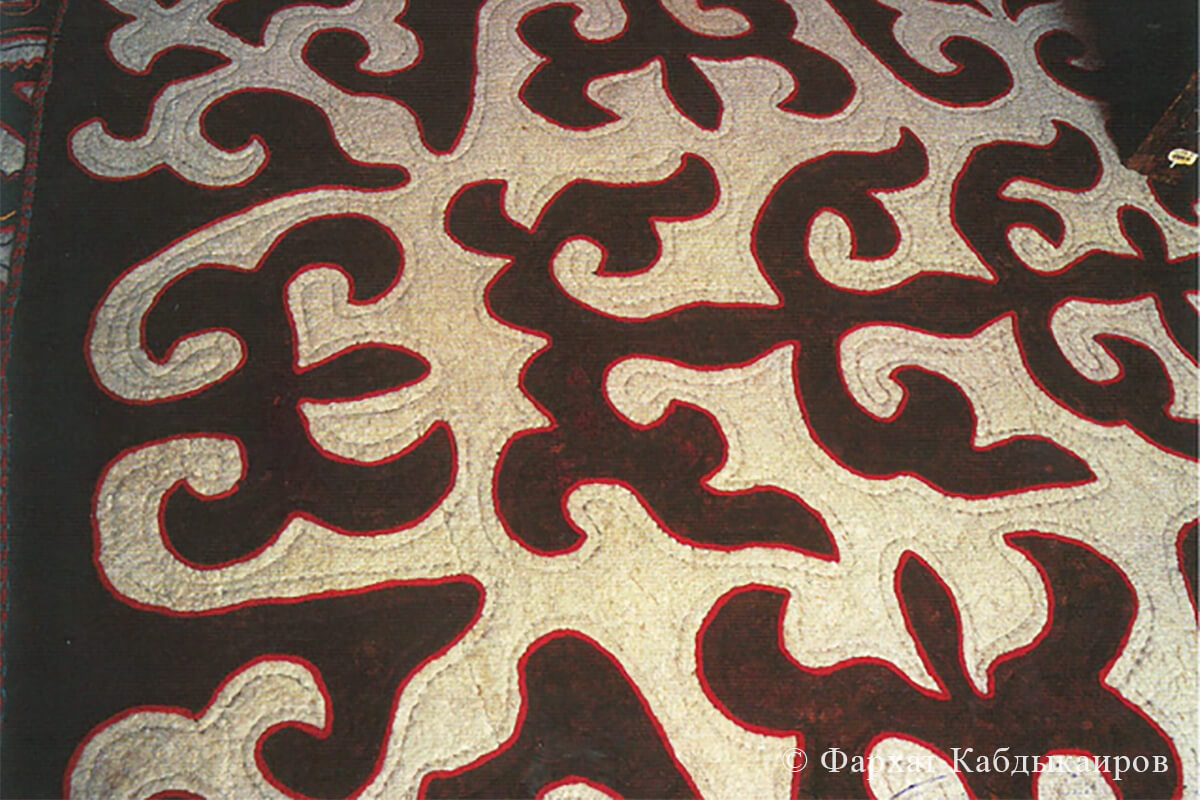
- Textiles: The finest woven and felt carpets are laid here, along with patterned carpet runners called alasha. Traditional felt rugs are widely used: tekemet (created by felting the pattern directly into the wool) and syrmaq (made using a mosaic applique technique).
- Storage System: Behind the guests, a row of carved wooden chests (sandýq) is arranged on the floor. Next to or on top of them, a special wooden stand called a júkayaq is placed. Bedding items — including blankets, pillows, and soft felt suitcases (shabadan) — are neatly stacked in high layers upon it. This entire stack of textiles is called júk and symbolizes the family's wealth.
3. The Women's Side — To the Right of the Entrance (sol bosağa)
This zone is located to the right of the door as you enter, but in the Kazakh language, it is called the left side (sol bosağa). This is because the sides of the yurt are traditionally determined from the inside — looking from the place of honor (tör) toward the exit.
- Household Items and Utensils: This is the hostess's territory, where kitchen utensils and tableware are kept. Located here are the kebeje (a wooden chest for storing food, flour, and grain) and the asadal (a tall cupboard on legs for dishes and food). Unique vessels made of thick leather for horse milk (koumiss) and cow's milk are also stored here: the torsyq, saba, süiretpe, and a large wineskin called a mes.
- Resting Area: Closer to the place of honor is the area for the older generation and children, where the wooden bed of the yurt owners (ağash tösek) is set up.
4. The Men's Side — To the Left of the Entrance (oñ bosağa)
For a entering guest, this zone is located to the left of the door, but in the Kazakh language, it is called the right side (oñ bosağa), as the calculation is made from the inside of the yurt.
- Men's Crafts and Equipment: Horse harnesses, saddles, weapons, and tools are stored here. Leather goods — such as girths (aiyl) and fastening straps (tartpa) — were created by master weavers (örimshi). For stitching leather products, taramys was used — extremely durable threads made from dried horse tendons. After processing animal hides, craftsmen sewed outerwear: ton (fur coats), shalbar (leather trousers), and tymaq (headwear), as well as etik (boots) and wide belts called kise.
- The Youth Area: Closer to the place of honor is the space for the son and his wife. Their wooden bed (ağash tösek) must be separated from the rest of the yurt by a fabric curtain — shymyldyq.
Vertical Decor and Artistic Heritage
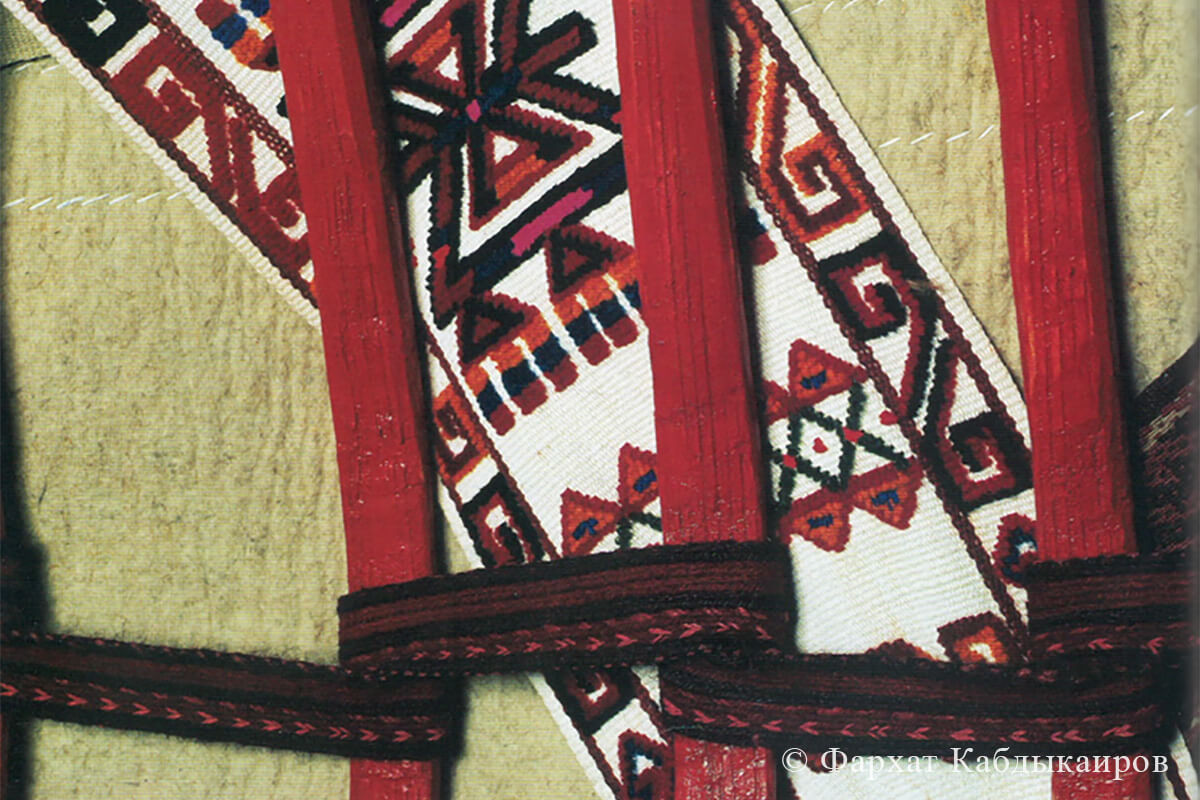
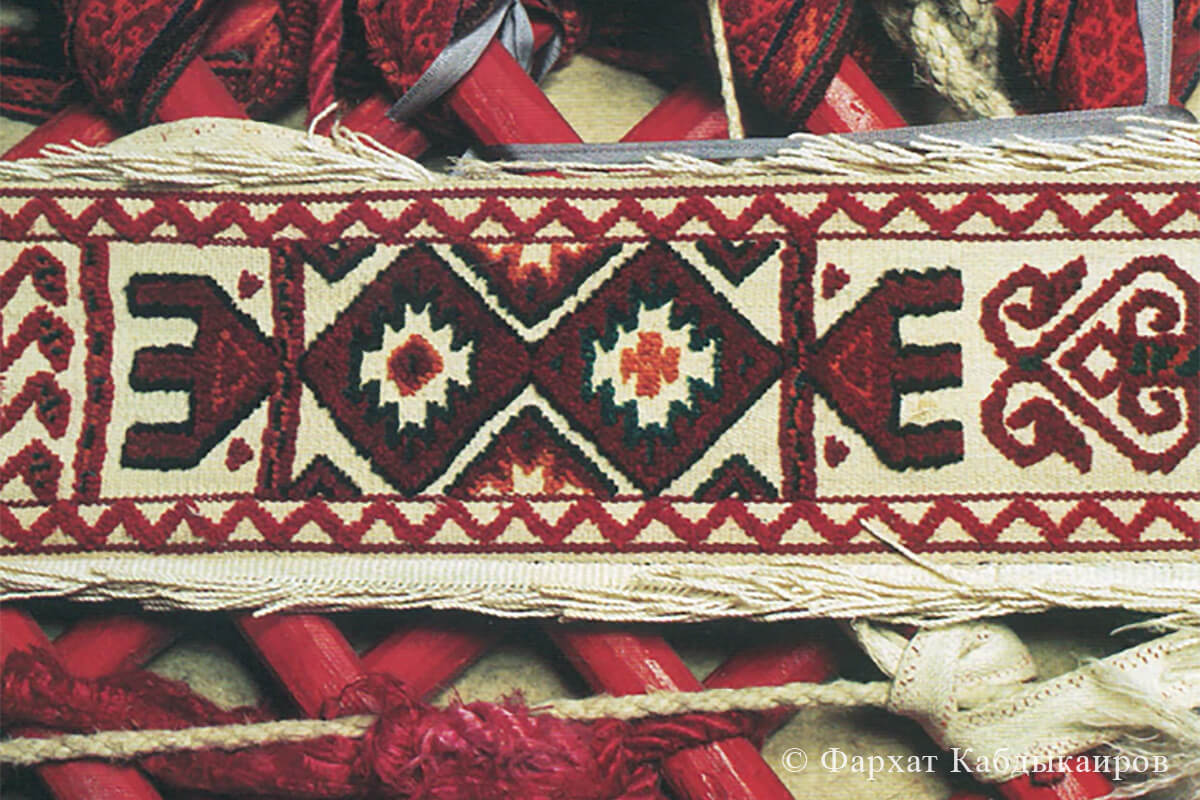
The walls and dome of the yurt are actively utilized for storage using patterned ribbons (bau):
- Carved wooden hanging poles (adalbaqan) are set up between the beds and the tör area.
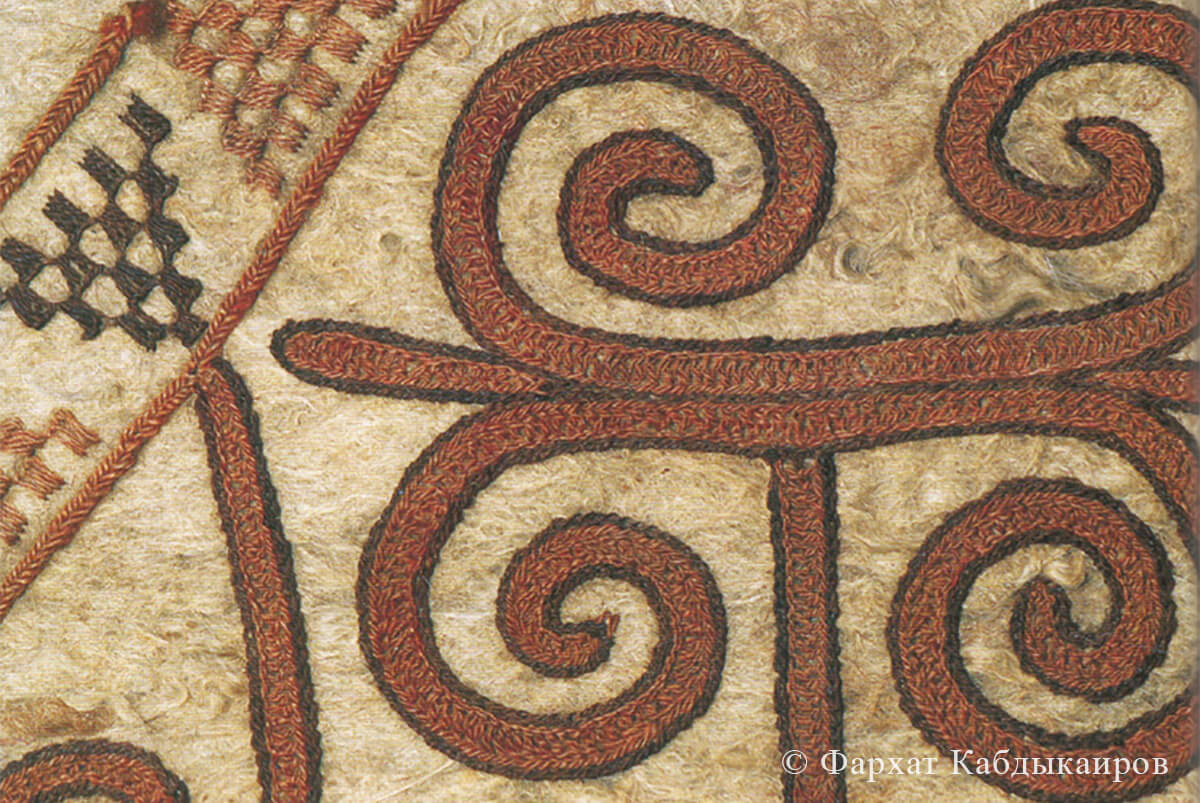
- Embroidered wall carpets (tuskiiz), saddlebags (qorjyn), woven pouches for small items (dorba), and felt bags for tableware (ayaqqap) are hung on the lattice walls (kerege). Festive ribbons with tassels (shashaq bau) hang down from beneath the dome, hooked onto the roof poles (uyq), while wide, elegant bands (bau-basqür) tightly wrap and secure the framework.
- Furniture, door frames, and tableware — such as wooden bowls (tostağan) and koumiss churn sticks (pispék) — were inlaid with horn and bone plates by folk bone-carvers (süiekshi). Jewelers (zerger) decorated everyday items using engraving, chasing, casting, and niello techniques.
Steppe Etiquette and Sacred Symbols
For a nomad, the yurt represented a model of the universe in miniature, where every element held deep spiritual significance, and rules of conduct inside the home were strictly regulated by centuries-old traditions.
The Sacred Threshold
According to traditional Kazakh beliefs, the door frames and the threshold of the yurt (bosağa) are a sacred place where the home's wealth, abundance, and well-being are concentrated. This sacred significance stems from an ancient belief in the mandatory unification of male and female principles within the space of the yurt.
For this reason, the entrance area is considered a strict boundary of the home. Stepping on the yurt's threshold or standing on it is categorically forbidden; in nomadic culture, this was viewed as a sign of deep disrespect to the hosts, capable of "trampling" their happiness and bringing misfortune. A guest must carefully step over the threshold and proceed to the side of the yurt indicated by the hosts. Sitting in the place of honor (tör) without an invitation is also considered a gross violation of etiquette.
Philosophy and Symbolism of the Shanyraq
If the hearth is the earthly heart of the yurt, the shañyraq is its spiritual peak, connecting man with the cosmos. While inside the home, nomads used the upper opening of the dome to determine the exact time of day by the movement of the sun's rays. Through the shañyraq, people received the pure energy of the sun and stars.
For every Kazakh, the shañyraq is a sacred symbol of the hearth, honor, family well-being, the continuation of the family line, and the unbroken connection between generations. It was the main family heirloom: it was never thrown away, but carefully passed down from father to the youngest son, as it was believed to contain great power and the patronage of ancestral spirits.
The symbolism of the dome is deeply reflected in Kazakh speech etiquette and blessings (bata):
- "Shañyrağyñ biik bolsyn!" — "May your shañyraq be high!" (a wish for wealth, greatness, and high status for the family).
- "Shañyrağyñ shaiqalmasyn!" — "May your shañyraq never shake!" (a wish for peace, stability, and a strong union, so that misfortunes bypass the home).
- The strict warning "Shañyraqqa qara!" ("Look at the shañyraq!") calls upon a person to respect the boundaries of decency, honor the traditions of the house, and remember who its rightful master is.
Caravansarai Yurts — Authentic Kazakh Hospitality
Everything you have just read about — from the unusual design of the yurt to the aesthetics of its traditional decoration — can be experienced in person. We invite you to stay at our ethno-campsite and discover the wonderful experience of living inside a traditional yurt.
Unique Architecture and Vibrant Decoration
Caravansarai Campsite is located inside the village of Basshi — at the gates of the Altyn-Emel State National Natural Park. There are 8 authentic yurts ready to welcome guests.
The main feature of a stay with us is the opportunity to live in a unique home with a spherical dome that has served the nomads of the Great Steppe for centuries. While inside, you can personally appreciate the perfection of this ancient structure and fall asleep gazing at the night sky through the open shañyraq. The interior of each yurt will delight you with its vibrant national character: the walls and floor are decorated with traditional carpets, wall panels, and elegant patterned ribbons, creating a uniquely warm atmosphere.
True Steppe Hospitality and Comfort
We have made sure that your immersion into the ethno-culture is both comfortable and heartwarming. Our guests can look forward to:
- Sincere Hospitality: Our staff are local residents of Basshi village. They will welcome you with true Kazakh hospitality and surround you with genuine care.
- Thoughtful Amenities: The well-maintained campsite territory features modern, clean sanitary zones (all facilities are within walking distance of the yurts).
- Hearty Meals: We offer our guests home-cooked dishes and warm conversation.
Caravansarai Campsite in Basshi village is a perfect opportunity to complement your visit to the Altyn-Emel National Park with a stay in a vibrant ethnic yurt and pay tribute to the great traditions of the nomads.
Contact Us:
- Address: 48 Assembek St., Basshi Village, Jetysu Region, Kazakhstan.
- Book Accommodation: +7 708 971 16 87 (WhatsApp)
- Book a Guide: +7 777 226 65 60 (WhatsApp)
- Campsite Location: Google Maps | Yandex | 2GIS