


Dominant (Common) Species of Plants
The flora of the Altyn-Emel National Park boasts a unique gene pool, comprising valuable plant groups such as medicinal, aromatic, edible, fodder, and ornamental species.
The park is home to plants from a wide range of natural zones: from floodplain forests (tugais) in river valleys to true and steppe-like deserts, as well as mountain steppes and alpine meadows. The park hosts both typically mountain species (Tianshan cherry, juniper, spiraea, bindweed) and inhabitants of lowland deserts and steppes (turanga, oleaster, winterfat, tasbiurgun, and various grasses).
In total, six main types of vegetation are identified within Altyn-Emel: aquatic, semi-aquatic, tugai, desert, steppe, and forest.
Of particular importance within these communities are the dominant and common species. These plants not only prevail in specific zones but also form the unique visual character of the park.
Some of Altyn-Emel's landscape plants (e.g., turanga, Schrenk's spruce, Tianshan birch) are endemics, unique to this region, while others are classified as rare and endangered species (e.g., gray-leaved turanga).
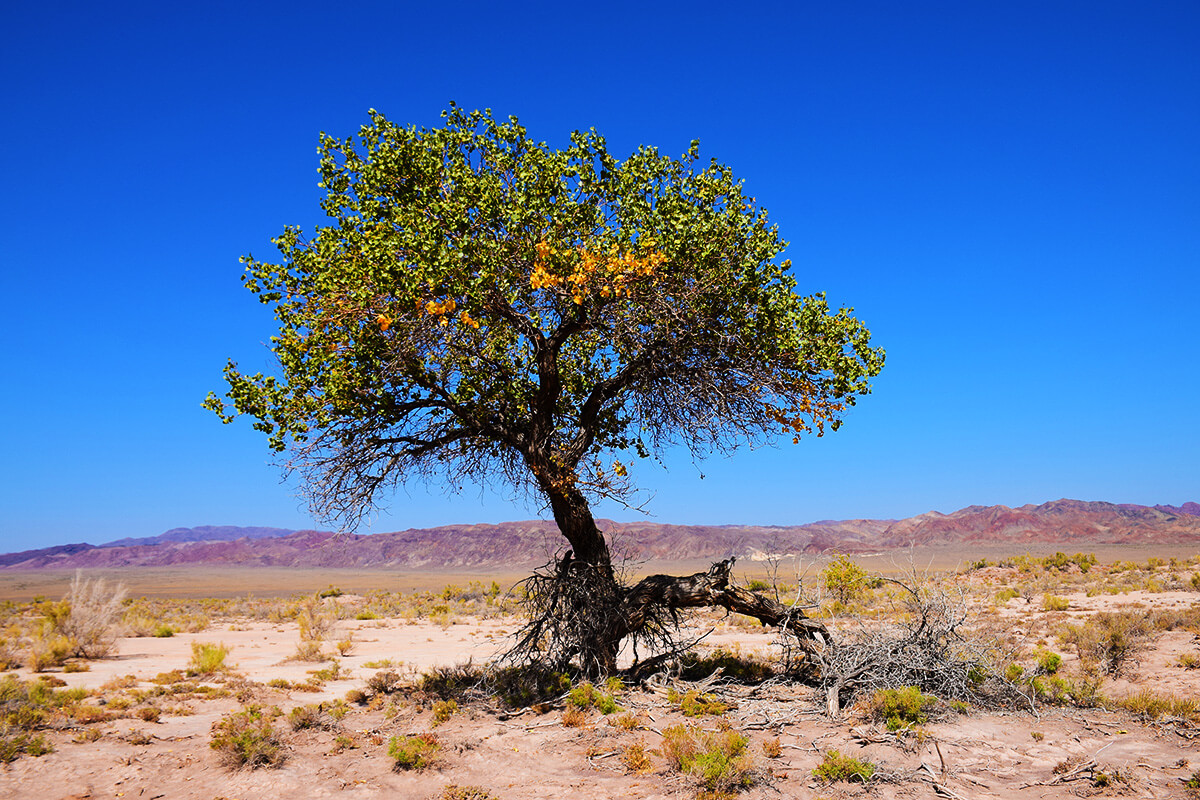
Turanga, or the Diverse-leaved Poplar — Populus diversifolia (Populus litwinowiana).
It grows along riverbanks and oxbow lakes, forming riparian (tugai) forests and woodlands. Along with the Pruinose Poplar (Populus pruinosa, the Red Data Book turanga), it is one of the dominant landscape plants in the Ili River valley.
The turanga is truly a tree of the Turanian deserts. This hardy relict plant is resilient to extreme temperature fluctuations, ranging from -35°C to +40°C. The tree stabilizes sandy soils and prevents desertification. The turanga's powerful root system anchors the sand, while its wide, spreading crown reduces wind speed.
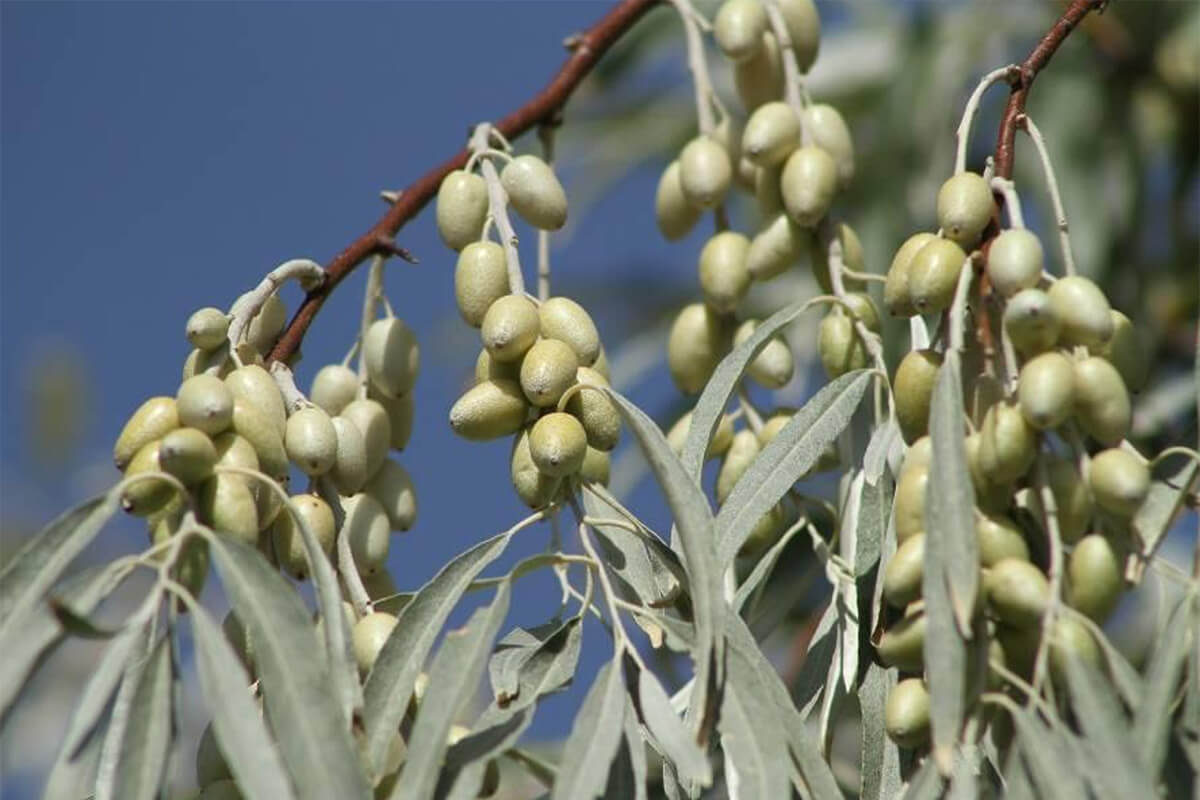
Sharp-fruited Oleaster (Jida) — Elaeagnus oxycarpa.
Grows on terraces and in the floodplain of the Ili River. One of the primary trees of the tugai forests.
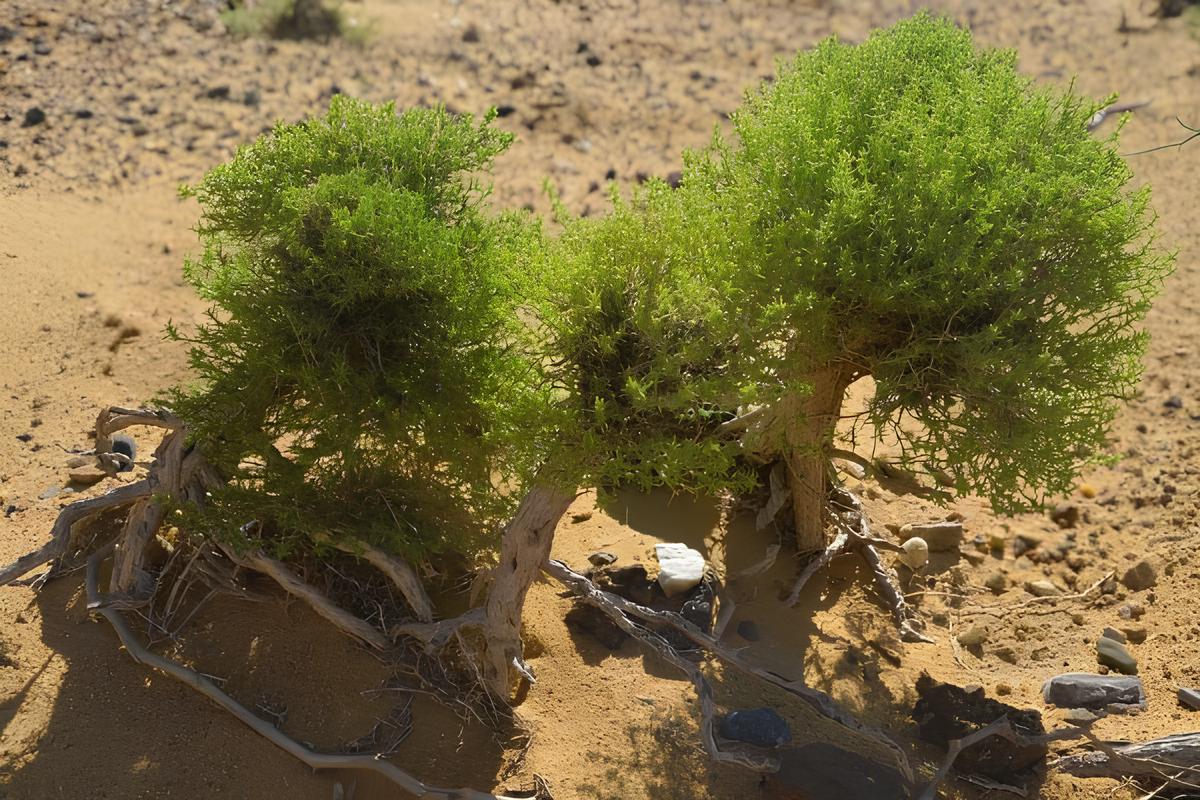
Ili Saksaulchik — Arthrophytum iliense.
Grows in the stony and gravelly deserts of the piedmont plains. One of the dominant landscape plants of the national park, especially in its eastern part.
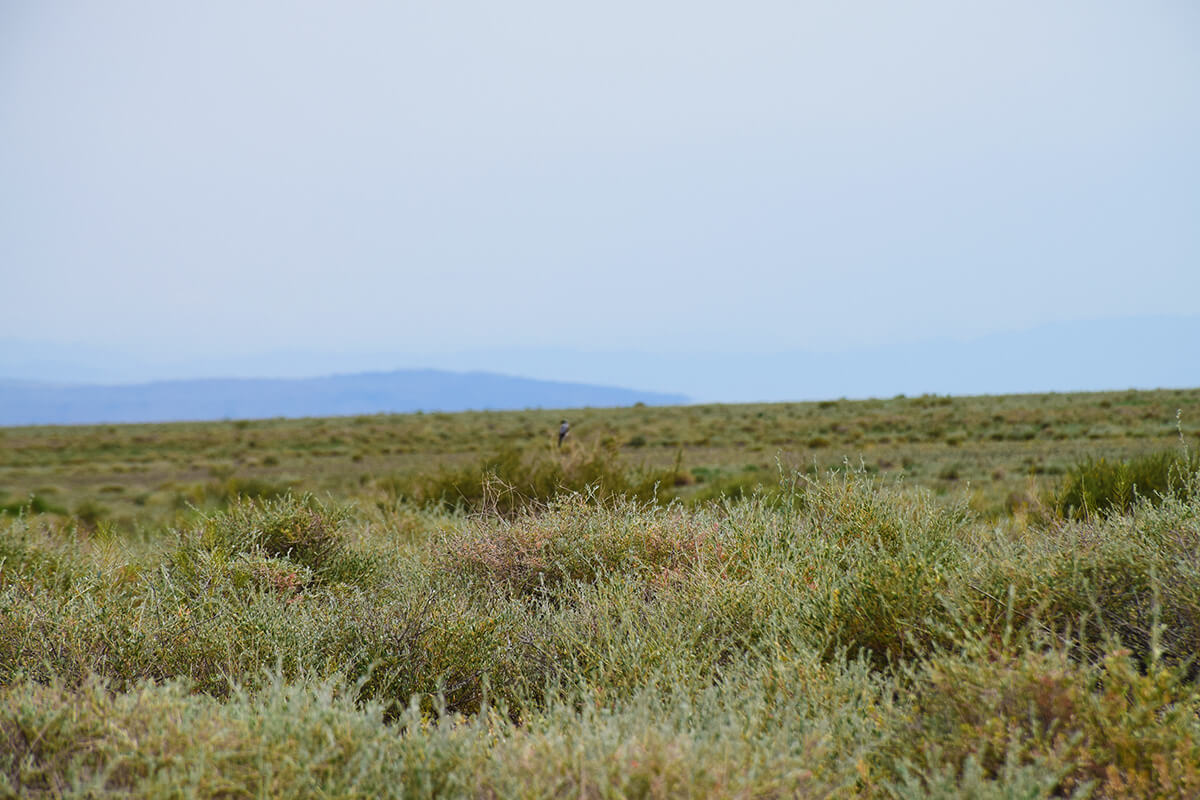
Winterfat (Teresken) — Krascheninnikovia ceratoides (Ceratoides papposa).
Grows on desert mountain outwash plains, on sands, and along dry washes. One of the dominant landscape plants of the national park.
Tasbiurgun — Nanophyton erinaceum.
Grows in the stony and gravelly deserts of the piedmont plains. One of the dominant landscape plants of the national park.
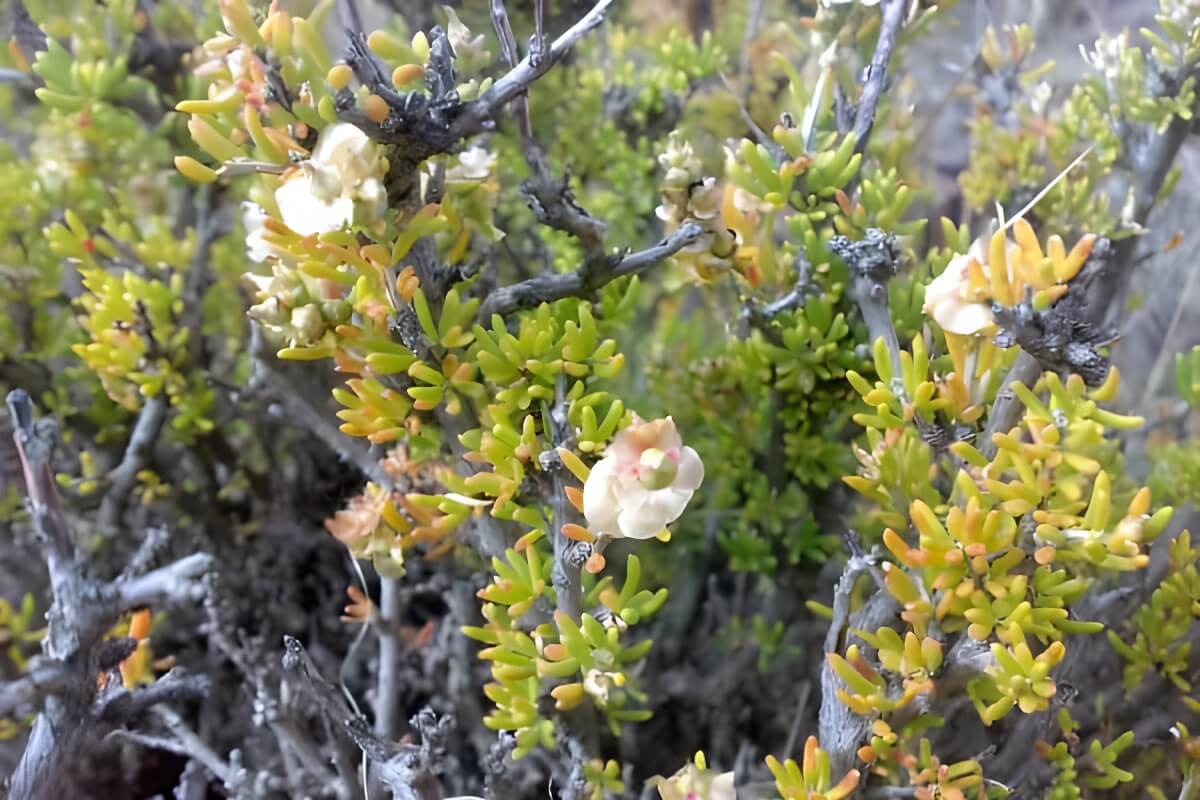
Boyalych Saltwort (Black Boyalych) — Salsola arbusculiformis.
Grows in stony and clay deserts, on rocks and screes of low mountains. One of the dominant landscape plants of the national park.
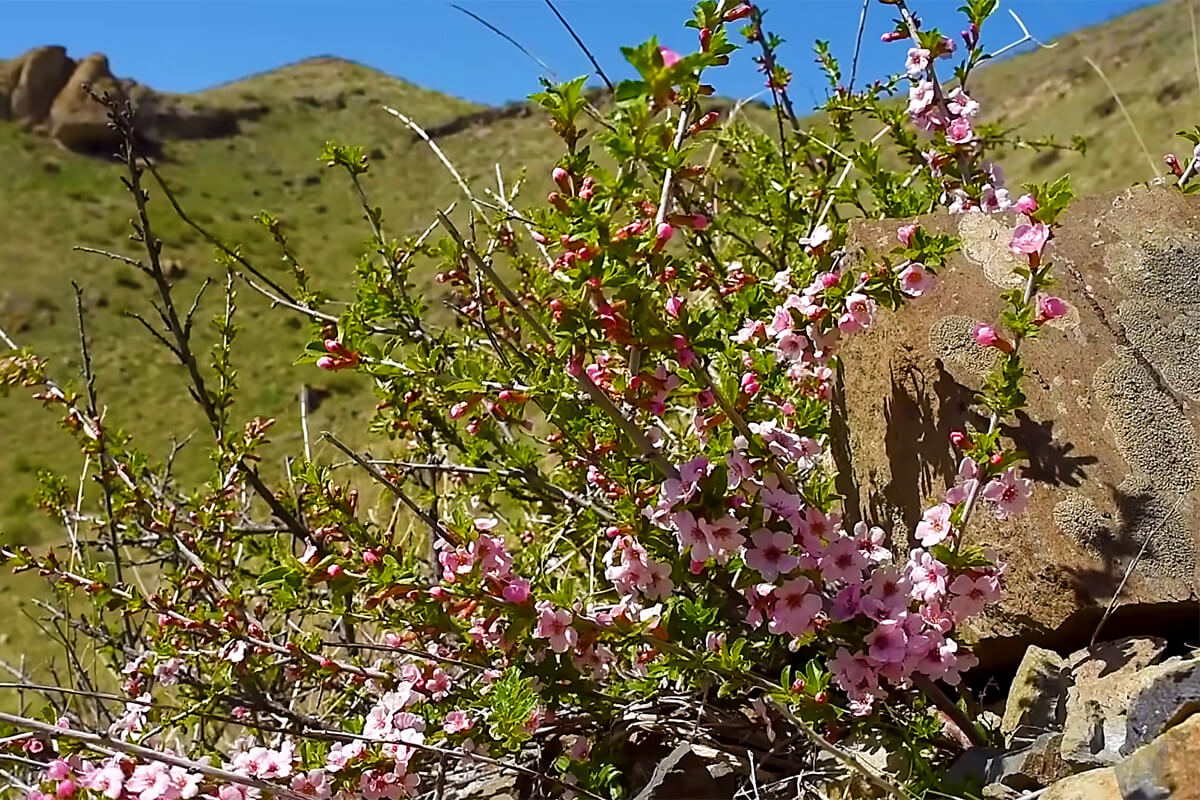
Tianshan Cherry — Cerasus tianschanica.
Grows on stony slopes and in shrub thickets. One of the primary landscape plants of the national park.
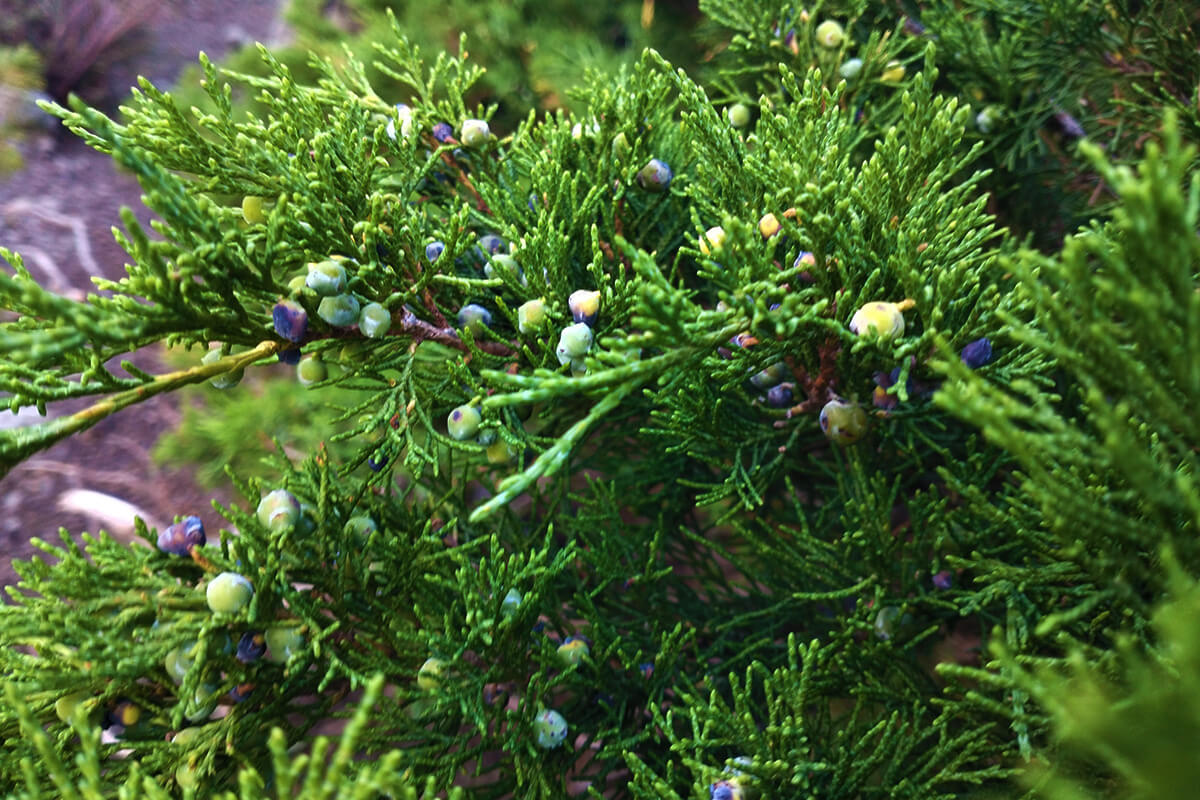
Savin Juniper — Juniperus sabina.
Grows on steep stony slopes, forming extensive thickets. One of the dominant landscape plants of the national park.
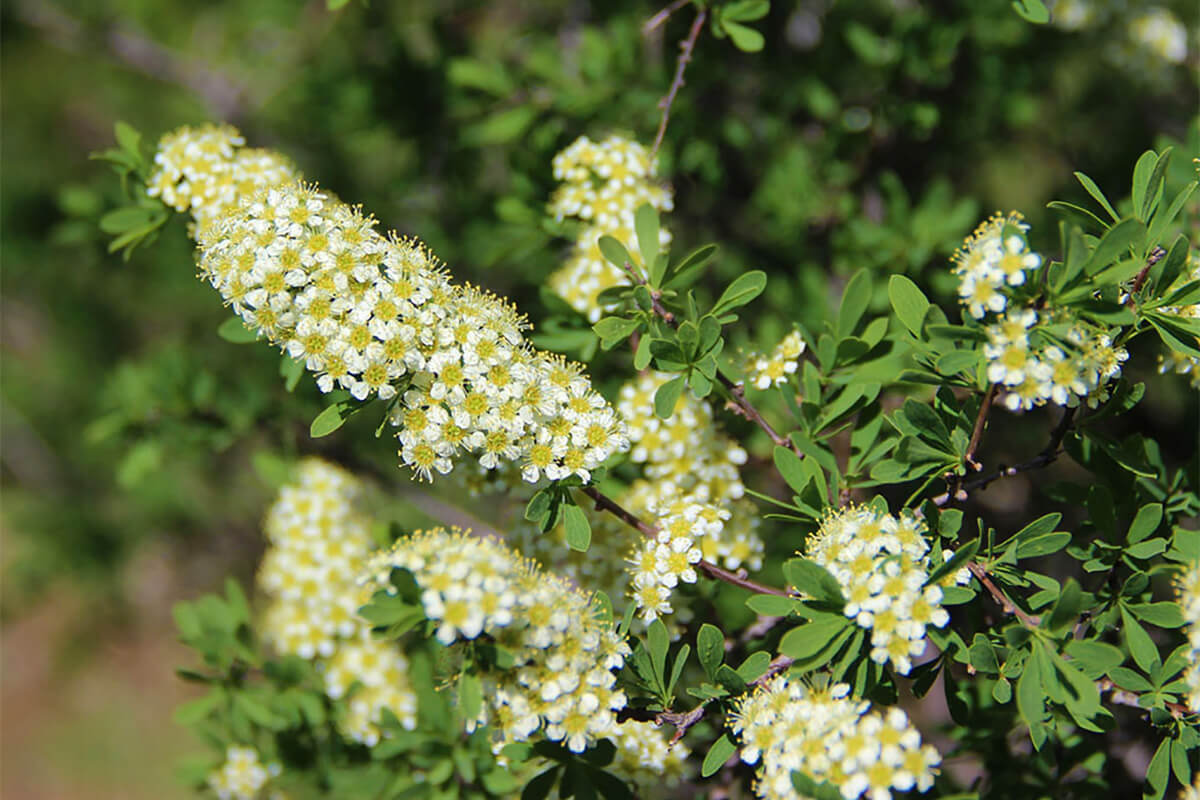
St. John's Wort-leaved Spiraea (Meadowsweet) — Spiraea hypericifolia.
Grows in mountain steppes, on mountain slopes, and in mountain river canyons, forming extensive thickets. One of the primary landscape plants of the park.
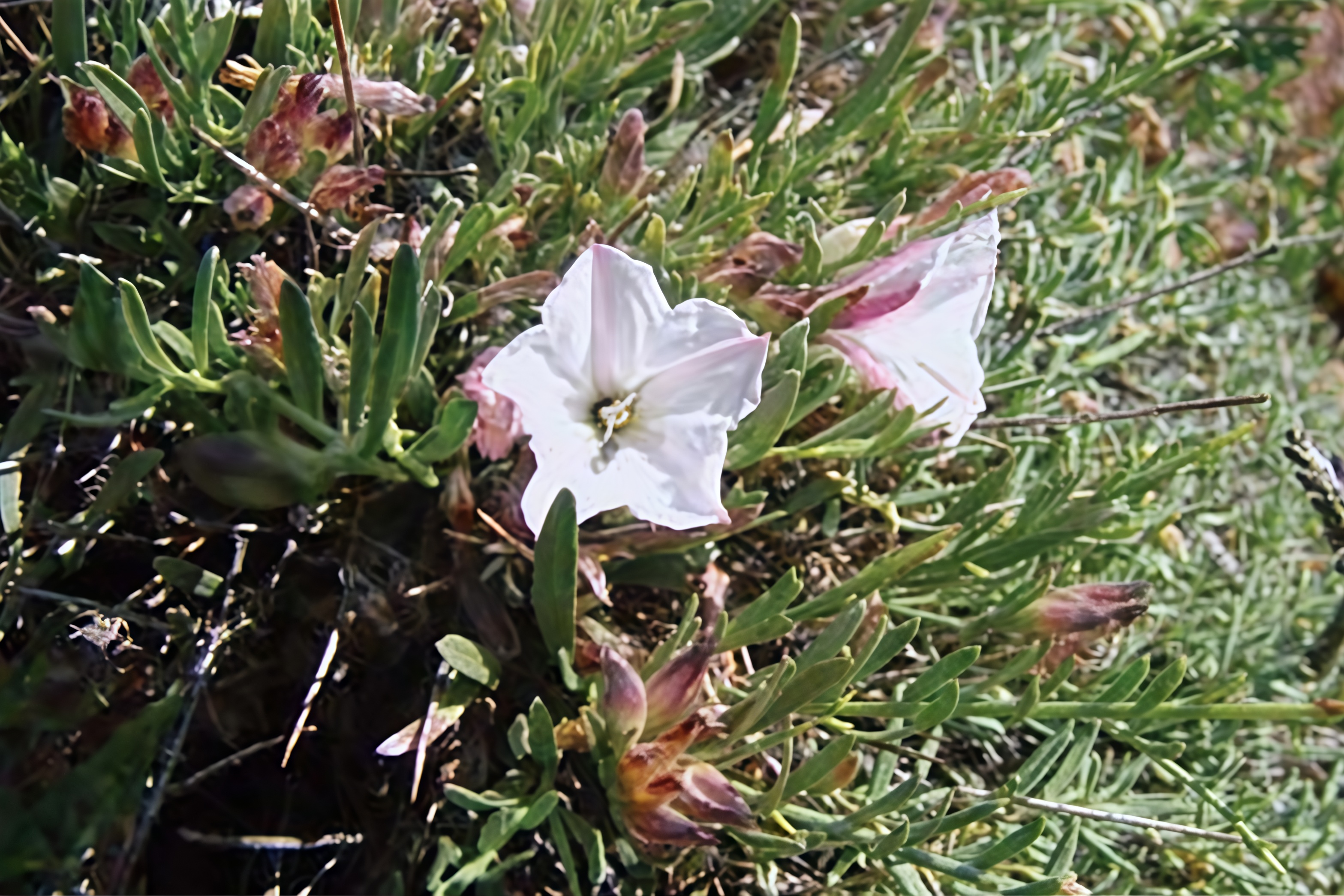
Tragacanth Bindweed — Convolvulus tragacanthoides.
Grows on the stony slopes of foothills and low mountains. One of the landscape plants of the park.
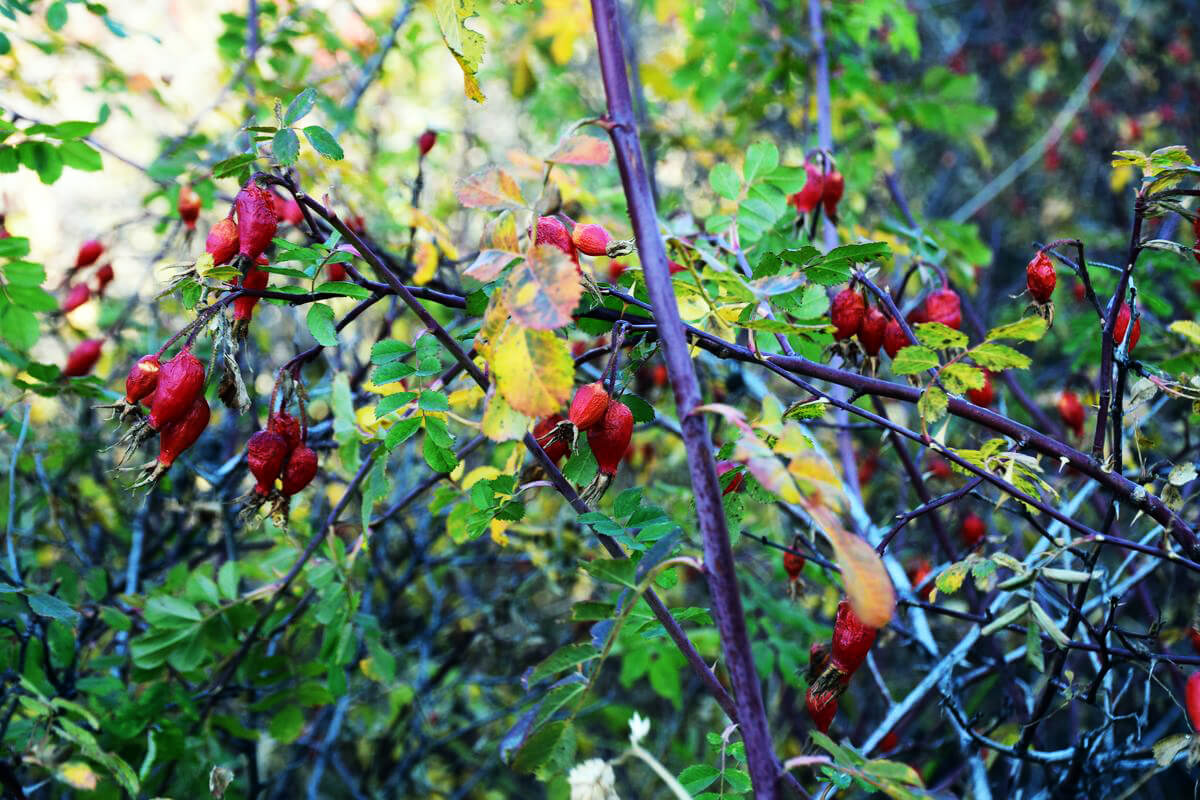
Rosehip — Rosa.
There are 6 species of rosehip (wild rose) growing in the region: Albert’s Rose (Rosa alberti), Begger’s Rose (Rosa beggeriana), Silverhjelm's Rose (Rosa silverhjelmii), Loose-growing Rose (Rosa laxa), Broad-spined Rose (Rosa platyacantha), and Burnet Rose, or Scotch Rose (Rosa pimpinellifolia).
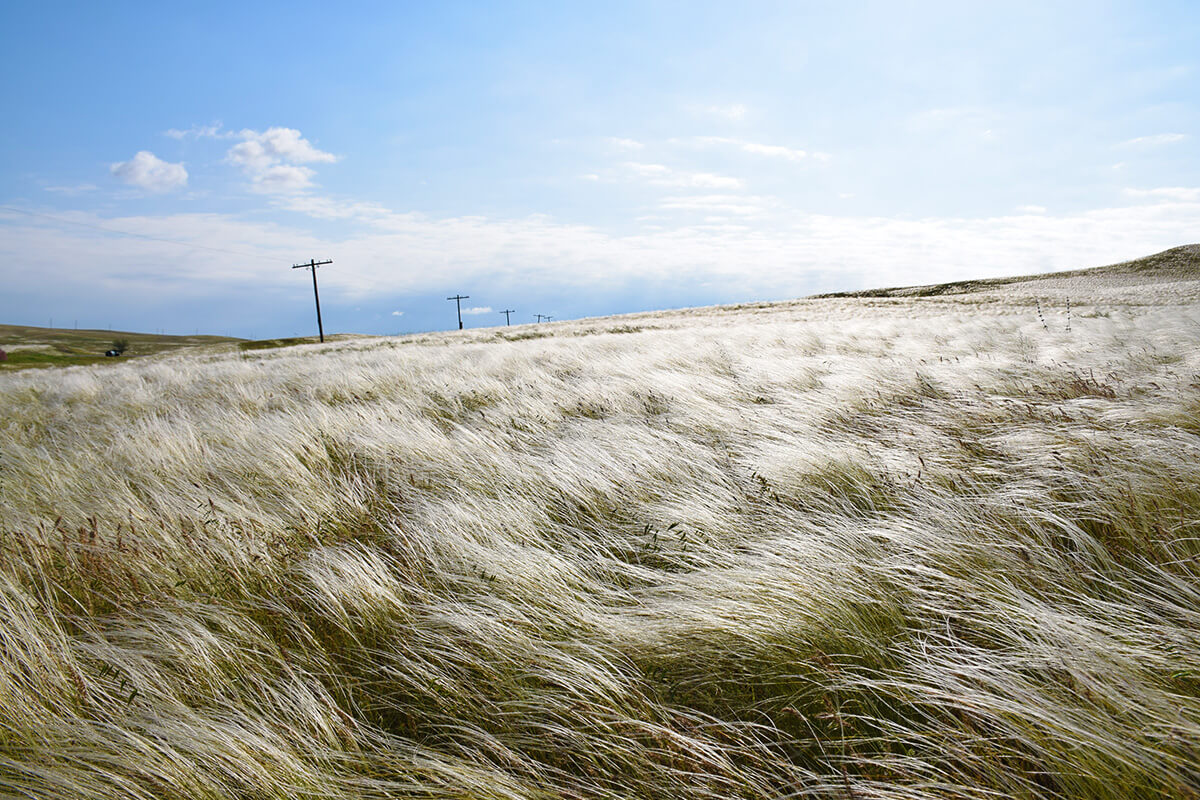
Feather Grass — Stipa.
There are 10 species of feather grass growing in the region: Caucasian Feather Grass (Stipa caucasica), Semirechye Feather Grass (Stipa heptapotamica), Oriental Feather Grass (Stipa orientalis), Kyrgyz Feather Grass (Stipa kirghisorum), Sarepta Feather Grass (Stipa sareptana), Long-tongued Feather Grass (Stipa macroglossa), Zalesski Feather Grass (Stipa zalesskii), Richter's Feather Grass (Stipa richteriana), Lessing Feather Grass (Stipa lessingiana), and Needle Grass, or European Feather Grass (Stipa capillata).
It belongs to the main dominants of steppe vegetation.
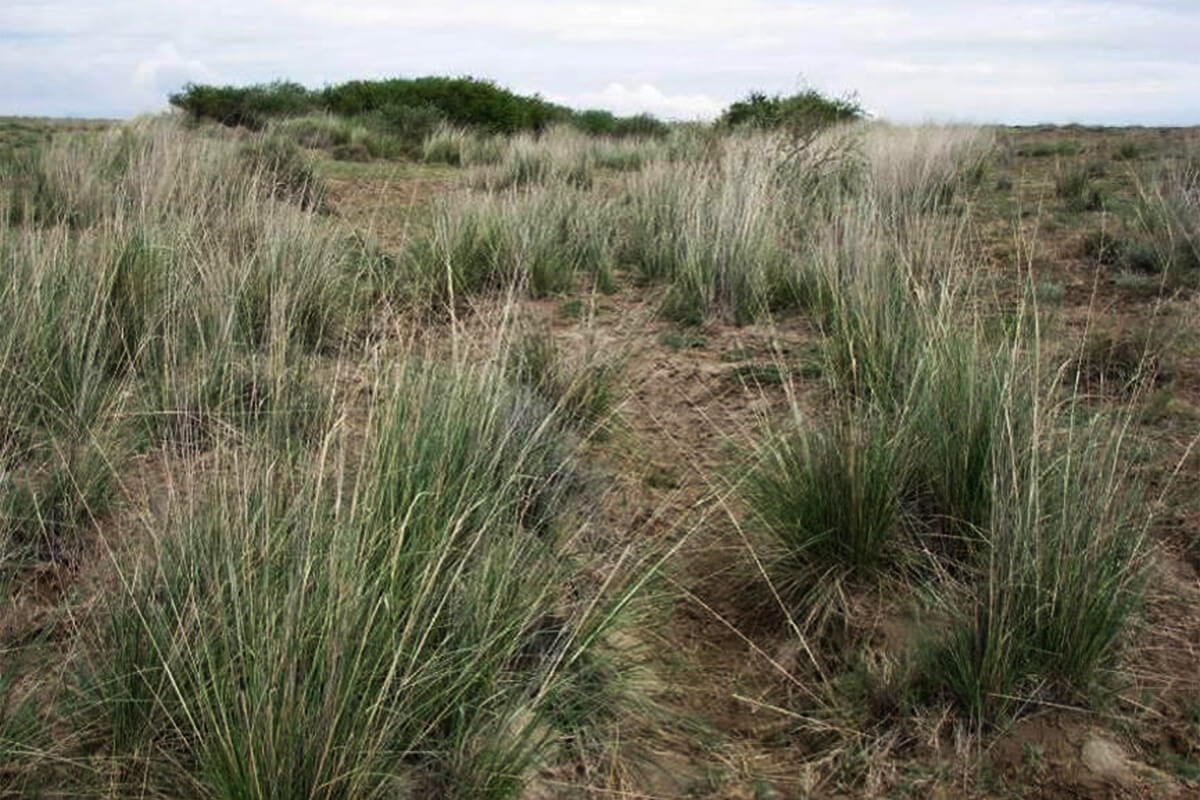
Cheegrass — Achnatherum.
Two species of cheegrass grow in the region: Caragana Cheegrass (Achnatherum caragana) and Shiny Cheegrass (Achnatherum splendens).
"Basshi" translated from Kazakh means "tall cheegrass" or "spiked cheegrass." Shi, or chee, is a grass often grouped with feather grass. It is widespread in the steppes and forms extensive thickets which cover about 2 million hectares in Kazakhstan.
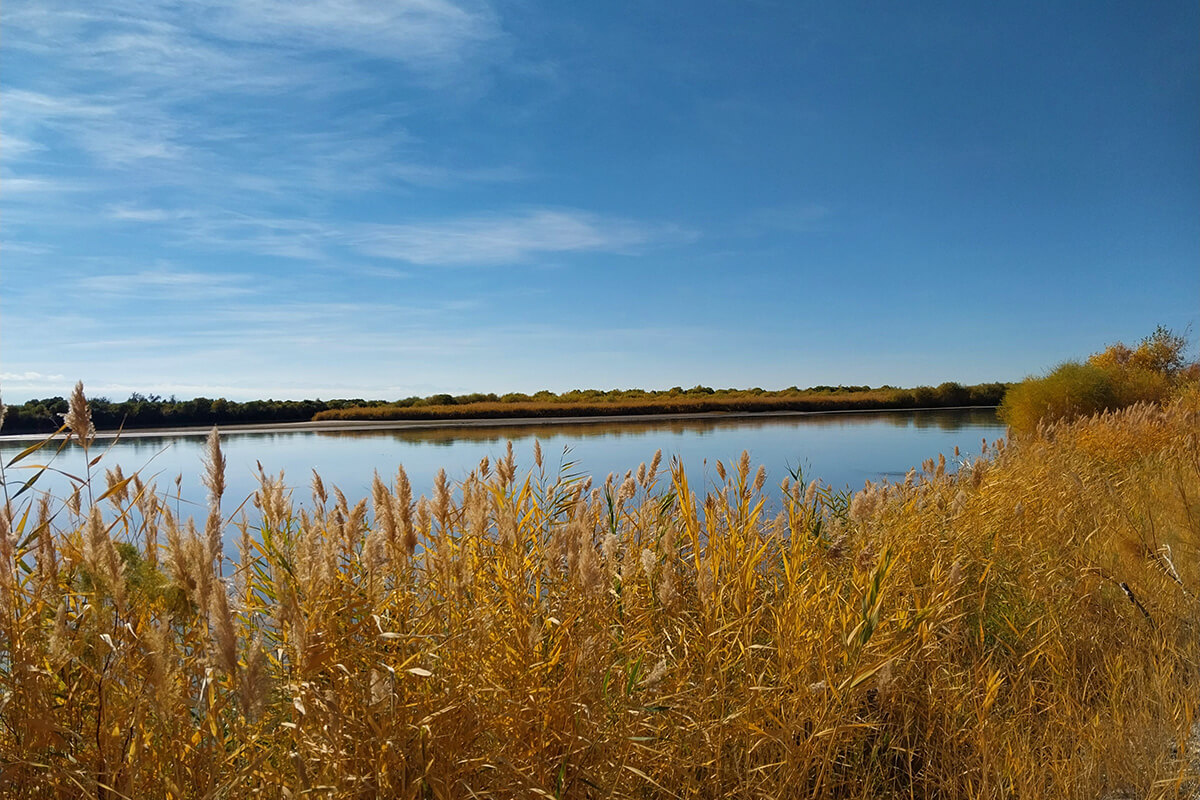
Common Reed — Phragmites australis.
Forms extensive thickets in the Ili River floodplain. Grows in relief depressions, often found along the banks of aryks (irrigation ditches).
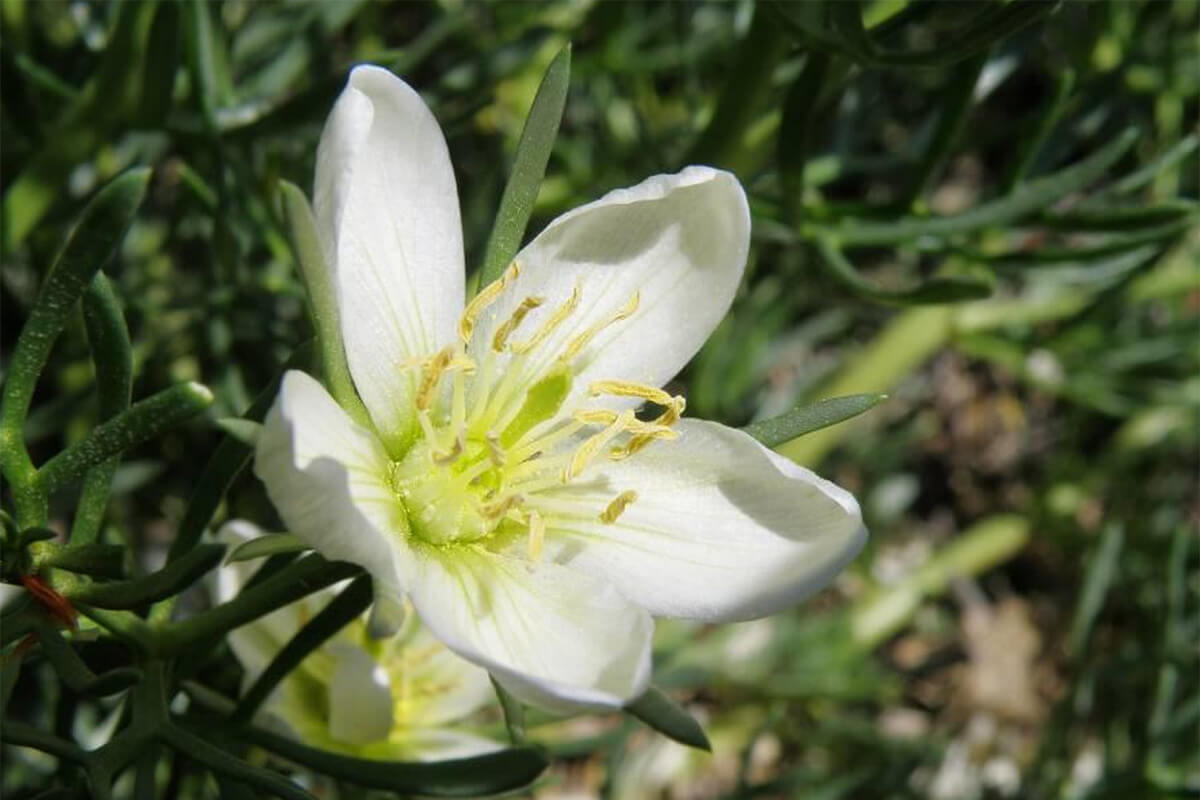
Adraspan (adyraspan), Syrian Rue — Peganum harmala.
Grows in deserts and dry steppes, forms thickets on overgrazed pastures, campsites, and in the vicinity of settlements.
In folk tradition, it is considered a mystical plant that wards off evil spirits; the dried herb is used for fumigating premises.
In addition to the main landscape-forming species, the flora of the national park includes a number of characteristic plants that are easily recognizable and frequently encountered in various natural zones (Schrenk's spruce, Tianshan birch, cistanche, acanthophyllum). Many of them are endemic (unique only to this region).
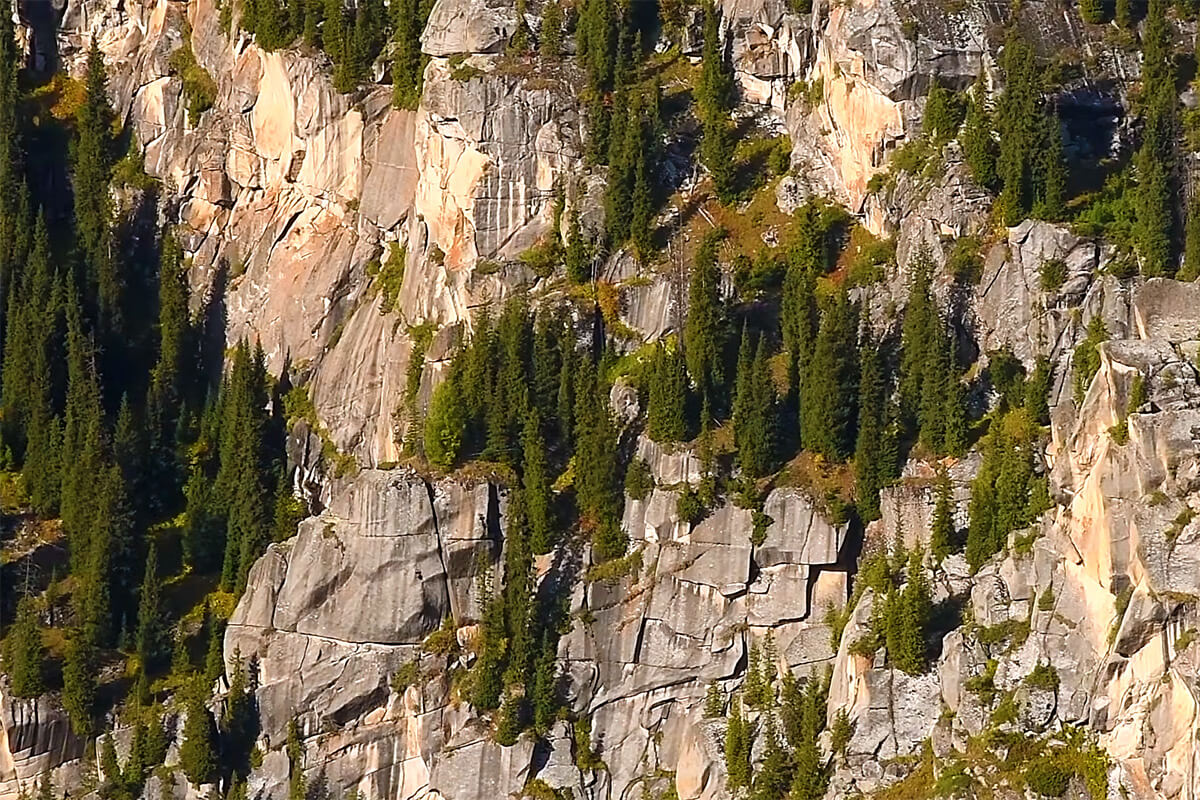
Schrenk's Spruce, Tianshan Spruce — Picea schrenkiana.
It grows on the northern slopes in the gorges of the Altyn-Emel ridge. The species is distinguished by its narrow, "cypress-like" shape.
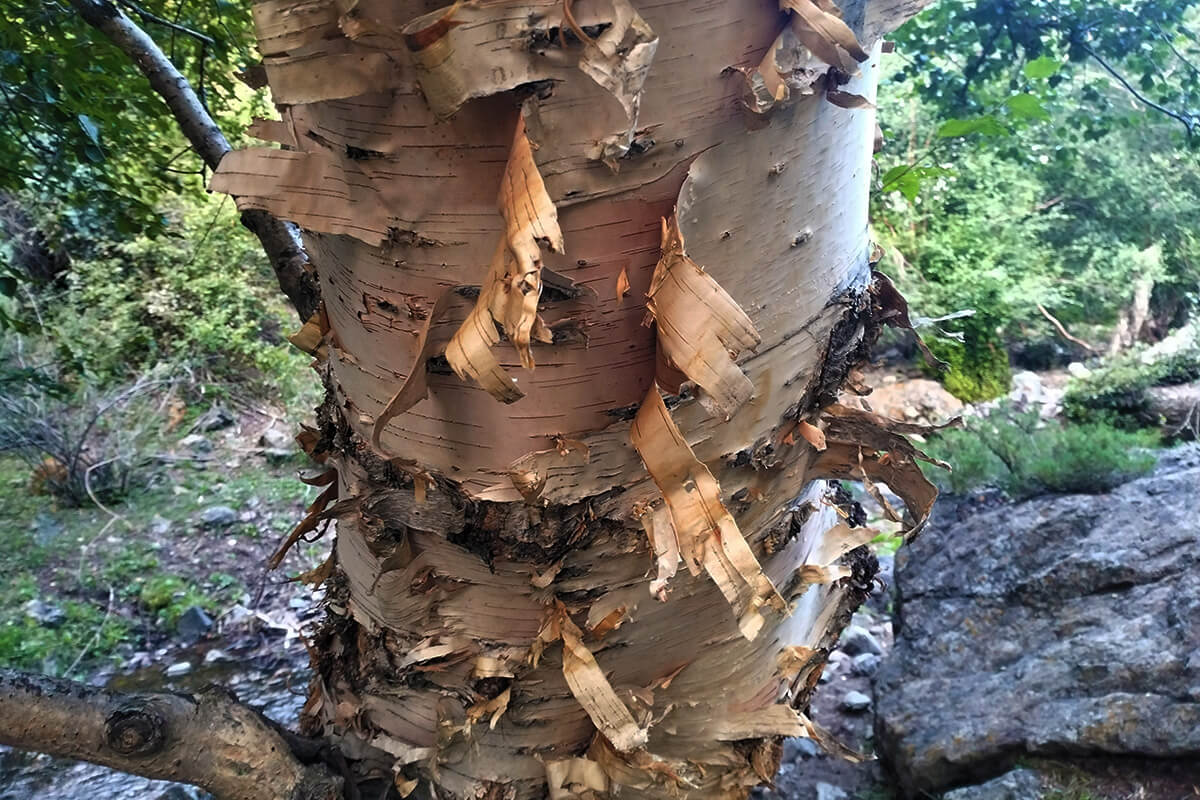
Tianshan Birch — Betula tianschanica.
Grows along the banks of mountain rivers and in the moist hollows of mountain slopes. A tree with pinkish-peach bark that peels off in thin parchment-like sheets.
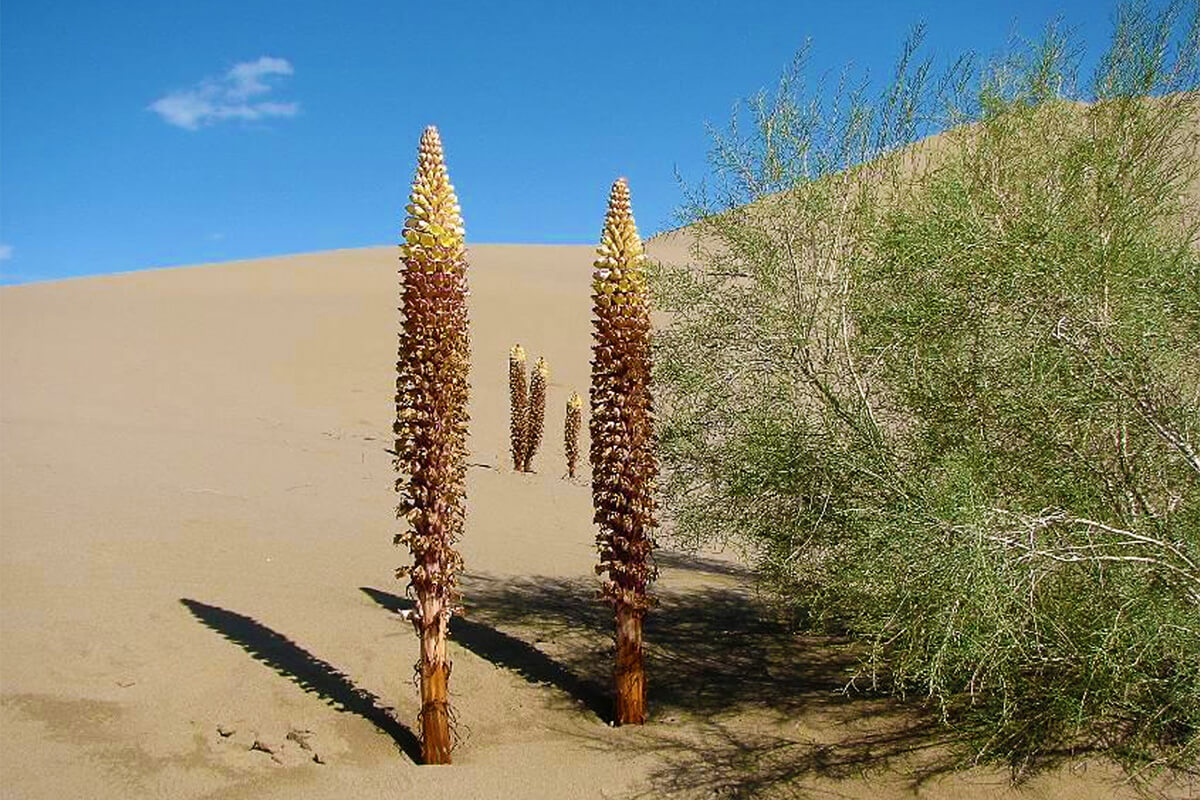
Salty Cistanche — Cistanche salsa.
It grows in clayey solonetzic deserts and on saline sands, parasitizing the roots of perennial saltworts.
The species can be found on the Singing Dune and in the Aktau Mountains.
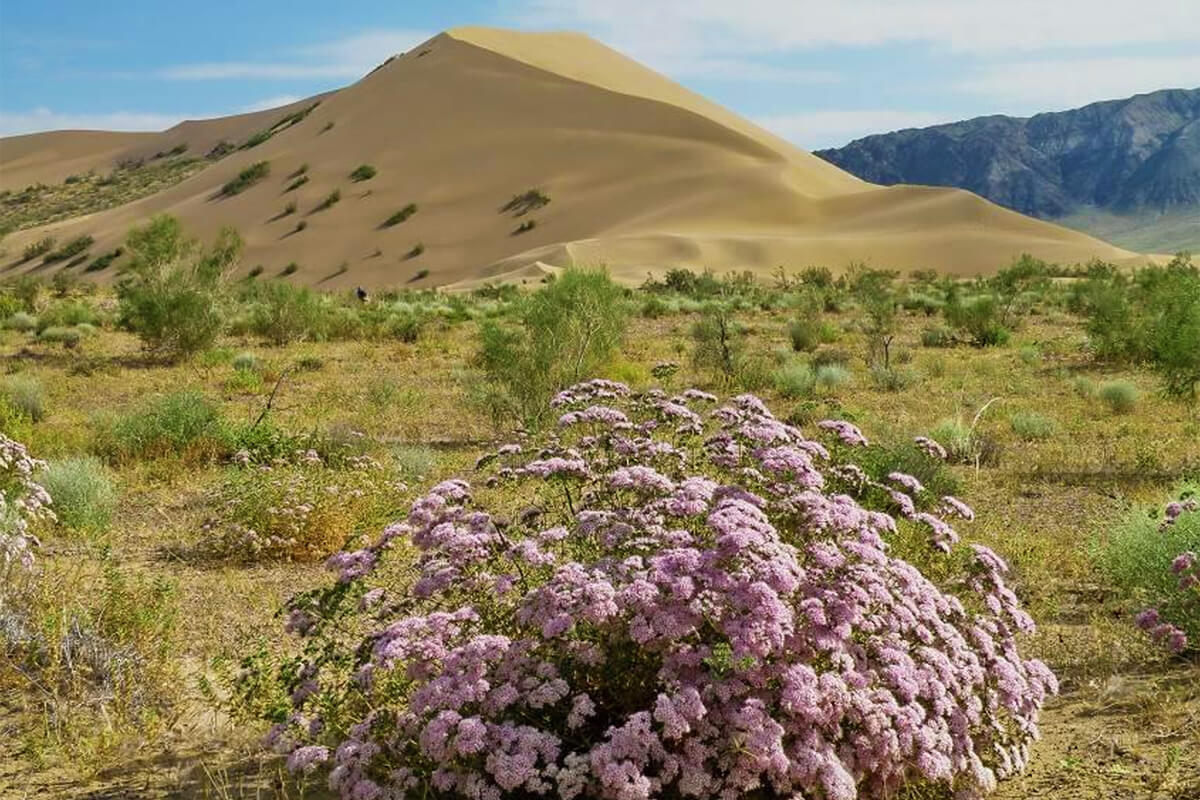
Prickly Acanthophyllum — Acanthophyllum pungens.
It grows along the dry riverbeds of deserts.
The species can be found on the Singing Dune and in the Aktau Mountains.
Classification
The flora of Altyn-Emel National Park is represented by 88 families, 403 genera, and 864 species, 29 of which are listed in the Red Data Book of Kazakhstan (marked with an asterisk).
As of 2019, this classification was supplemented by 88 species from 30 families, 4 of which had not been previously recorded. Thus, to date, it is represented by 952 species from 92 families.
Woodsia ilvensis (L.) R. Br.
Суstopteris fragilis (L.) Bernh.
Dryopteris filix-mas (L.) Schott
Asplenium septentrionale (L.) Hoffm.
А. trichomanes L.
А. ruta-muraria L.
Сеterach officinarum Willd.
Cheilanthes persica (Bory) Mett. ex Kuhn
Роlypodium vulgare L.
Botrychium lunaria (L.) Sw.
Equisetum arvense L.
E. palustre L.
Е. ramosissimum Desf.
Picea schrenkiana Fisch. et C.A. Mey.
Juniperus sibirica Burgsd.
J. pseudosabina Fisch. et C.A. Mey.
J sabina L.
Ерhedra przewalskii Stapf
E. equisetina Bunge
Е. intermedia Schrenk et C.A. Mey.
Typha angustifolia L.
T. latifolia L.
Т. minima Funck
Тriglochin maritimum L.
Т. раlustre L.
Butomus umbellatus L.
Brachypodium pinnatum (L.) Beauv.
Elytrigia alatavica (Drob.) Nevski
Е. repens (L.) Nevski
Е. trichophora (Link) Nevski
Elymus schrenkianus (Fisch. et C.A. Mey.) Tzvel.
Аgropyron fragile (Roth) P. Candargy
А. сristatum (L.) Beauv.
Еremopyrum triticeum (Gaertn.) Nevski
E. bonaepartis (Sperng.) Nevski
Е. orientale (L.) Jaub. et Spach.
Aegilops cylindrica Host
Leymus angustus (Trin.) Pilg.
L. multicaulis (Kar. et Kir.) Tzvel.
L. secalinus (Georgi) Tzvel.
Рsathyrostachys juncea (Fisch.) Nevski
Р. kronenburgii (Hack.) Nevski
Ноrdeum brevisubulatum (Trin.) Link
Н. bogdanii Wilensky
H. geniculatum All.
Taeniatherum crinitum (Schreb.) Nevski
Вromopsis inermis (Leyss.) Holub
Аnisantha tectorum (L.) Nevski
Вromus japonicus Thunb.
В. squarrosus L.
В. oхуdon Schrenk
Avena fatua L.
Trisetum sibiricum Rupr.
T. spicatum (L.) K. Richt.
T. altaicum Roshev.
Неlictorichon pubescens (Huds.) Pilg.
H. hookeri (Scribn.) Henrard.
Н. altaicum Tzvel.
Koeleria cristata (L.) Pers.
Milium effusum L.
Саlamagrosis epigeios (L.) Roth
С. pseudophragmites (Hall. fil.) Koel.
С. dubia Bunge
Apera interrupta (L.) Beauv.
Agrostis gigantea Roth
Polypogon monspeliensis (L.) Desf.
Anthoxanthum alpinum A. et D. Love
Hierochloe odorata (L.) Beauv.
Phleum phleoides (L.) Karst.
P. pratense L.
P. alpinum L.
Аlopecurus pratensis L.
А. arundinaceus Poir
Festuca valesiaca Gaudin
F. alatavica (St.-Yves) Roshev
F. rubra L.
F. kryloviana Reverd.
Poa alpina L.
Р. bulbosa L.
Р. annua L.
Р. рratensis L.
P. angustifolia L.
P. sibirica Roshev.
Р. trivialis L.
P. nemoralis L.
Р. transbaicalica Roshev.
Рuccinellia gigantea (Grossh.) Grossh.
P. distans (Jacq.) Parl.
Dactylis glomerata L.
Melica altissima L.
М. transsilvanica Schur
Achnatherum caragana (Trin.) Nevski
Асhnatherum splendens (Trin.) Nevski
Stipa caucasica Schmalh.
S. heptapotamica Golosk.
S. orientalis Trin.
S. richteriana Kar. et Kir.
S. lessingiana Trin. et Rupr.
S. macroglossa P. Smirn.
S. kirghisorum P. Smirn.
S. zalesskii Wilensky
S. сарillata L.
S. sareptana A. Beck.
Piptatherum songaricum (Trin. et Rupr.) Roshev. ex E. Nikit.
Phragmites australis (Cav.) Trin. ex Steud.
Schismus arabicus Nees
Саtabrosella humilis (Bieb.) Tzvel.
Аristida heymannii Regel
Stipagrostis pennata (Trin.) de Winter
Аеluropus littoralis (Gouan) Parl.
Cleistogenes squarrosa (Trin.) Keng
C. songorica (Roshev.) Ohwi
Eragrostis minor Host
Cynodon dactylon (L.) Pers.
Crypsis schoenoides (L.) Lam.
C. aculeata (L.) Ait.
Воthriochloa ischaemum (L.) Keng
Setaria viridis (L.) Beauv.
S. pumila (Poir.) Schult.
Суреrus fuscus L.
Scirрus tabernaemontani C.C. Gmel.
S. lacustris L.
Воlboschoenus maritimus (L.) Palla
В. planiculmis (Fr. Schmidt) Egor.
Eleocharis uniglumis (Link) Schult.
Kobresia capilliformis Ivanova
K. humilis (C.A. Mey. ex Trautv.) Serg.
Сarex melanostachya Bieb. ex Willd.
С. songorica Kar. et Kir.
C. acutiformis Ehrh.
C. aneurocarpa V. Krecz.
С. minutiscabra Kuk. ex V. Krecz.
С. turkestanica Regel
С. stenocarpa Turcz. ex V. Krecz.
C. aterrima Hoppe
C. melanantha C.A. Mey.
C. praecox Schreb.
C. dimorphotheca Stschegl.
C. physodes Bieb.
Juncus bufonius L.
J. compressus Jacq.
J. gerardii Loisel.
J. brachytepalus V. Krecz. et Gontsch.
J. articulatus L.
Luzula sibirica V. Krecz.
Eremurus altaicus (Pall.) Stev.
E. inderiensis (Stev.) Regel
Е. robustus (Regel) Regel
Gagea dschungarica Regel
G. filiformis (Ledeb.) Kar. et Kir. (G. sacculifera Regel)
G. emarginata Kar. et Kir.
G. bulbifera (Pall.) Salisb.
*Fritillaria pallidiflora Schrenk
*Тulipa alberti Regel
*Т. kolpakowskiana Regel
*T. brachystemon Regel
T. buhseana Boiss.
Allium strictum Schrad.
A. schrenkii Regel
A. obliquum L.
A. oreoprasum Schrenk
A. platyspathum Schrenk
A. setifolium Schrenk
A. kokanicum Regel
A. goloskokovii Vved.
A. korolkowii Regel
A. atrosanguineum Kar. et Kir.
A. karelinii Poljak.
A. shoenoprasum L.
А. galanthum Kar. et Kir.
А. pallasii Murr.
A. caeruleum Pall.
А. cаеsium Schrenk
A. sсhoenoprasioides Regel
A. oreophilum C.A. Mey.
A. sabulosum Stev. ex Bunge
Asparagus neglectus Kar. et Kir.
A. angulofractus Iljin
A. persicus Baker
Ixiolirion tataricum (Pall.) Schult. et Schult. fil.
Сrocus alatavicus Regel et Semen.
Iris songarica Schrenk
I. tenuifolia Pall.
I. pallasii Fisch. ex Trev.
I. bloudowii Ledeb.
I. scariosa Willd. ex Link
I. sogdiana Bunge
I. halophila Pall.
Dactylorhisa umbrosa (Kar. et Kir.) Nevski
Salix alba L.
S. triandra L.
S. songarica Anderss
S. pentandra L.
S. iliensis Regel
S. turanica Nas.
S. cinerea L.
S. tenuijulis Ledeb.
S. kirilowiana Stschegl.
S. michelsonii Goerz. ex Nas.
S. wilhelmsiana Bieb
Рopulus tremula L.
Р. diversifolia Schrenk (P. litwinowiana Dode)
*P. pruinosa Schrenk
Betula tianschanica Rupr.
Ulmus pumila L.
*Celtis caucasica Willd.
Саnnabis ruderalis Janisch.
Urtica cannabina L.
U. dioica L.
Oxyria digyna (L.) Hill.
Rumex acetosa L.
R. crispus L.
R. pamiricus Rech. fil.
R. marschallianus Reichenb.
*Rheum wittrockii Lundstr.
Rh. tataricum L. fil.
Rh. spiciforme Royle
Аtraphaxis spinosa L.
A. replicata Lam.
А. pyrifolia Bunge
А. frutescens (L.) C. Koch
А. virgata (Regel) Krasn.
Роlygonum aviculare L.
P. cognatum Meissn. (Р. rupestre Kar. et Kir.)
Р. patulum Bieb.
Persicaria amphibia (L.) S.F. Gray (Polygonum amphibium L.)
P. minor (Huds.) Opiz (Polygonum minus Huds.)
Aconogon alpinum (All.) Schur (Polygonum alpinum All.)
A. coriarium (Grig.) Sojak (P. coriarium Grig.)
Bistorta elliptica (Willd. ex Spreng.) Kom. (Polygonum nitens (Fisch. et Mey) V. Petr.)
B. vivipara (L.) S.F. Gray (Polygonum viviparum L.)
Сhenopodium botrys L.
С. rubrum L.
С. album L.
C. acuminatum Willd.
Аtriplex littoralis L.
А. dimorfostegia Kar. et Kir.
A. tatarica L.
A. cana C.A. Mey.
Halimione verrucifera (Bieb.) Aell.
Krascheninnikovia ceratoides (L.) Gueldenst. (Сеratoides papposa Botsch. et Ikonn.)
Сеratocarpus arenarius L.
С. utriculosus Bluk.
Axyris amaranthoides L.
А. hybrida L.
Саmphorosma monspeliensis L.
Раnderia turkestanica Iljin
Kirilowia eriantha Bunge
Bassia hyssopipholia (Pall.) O. Kuntze
B. sedoides (Pall.) Aschers.
Kосhia prostrata (L.) Schrad.
K. odontoptera Schrenk
K. scoparia (L.) Schrad.
K. densiflora (Moq.) Aell. (K. sieversiana (Pall.) C. A. Mey.)
Corispermum heptapotamicum Iljin
C. orientale Lam.
Agriophyllum squarrosum (L.) Moq.
Kаlidium foliatum (Pall.) Moq.
K. caspicum (L.) Ung.-Sternb.
K. schrenkianum Bunge ex Ung.-Sternb.
Наlostachys belangeriana (Moq.) Botsch. (H. caspica (Bieb.) C. A. Mey.)
Наlocnemum strobilaceum (Pall.) Bieb.
Salicornia europaea L.
Suaeda linifolia Pall.
S. altissima (L.) Pall.
S. dendroides (C.A. Mey.) Moq.
S. аcuminata (C.A. Mey.) Moq.
S. physophora Pall.
Borsczowia aralocaspica Bunge
Salsola australis R. Br.
S. rosacea L.
S. dschungarica Iljin
S. аrbuscula Pall.
S. аrbusculiformis Drob.
S. оrientalis S.G. Gmel.
S. foliosa (L.) Schrad.
Сlimacoptera оbtusifolia (Schrenk) Botsch.
C. affinis (C.A. Mey.) Botsch.
С. brachiata (Pall.) Botsch.
Ноraninovia ulicina Fisch. et C.A. Mey.
Ofaiston monandrum (Pall.) Moq.
Girgensohnia oppositiflora (Pall.) Fenzl
Аnabasis salsa (C.A. Mey.) Benth. ex Volkens
А. еriopoda (Schrenk) Benth. ex Volkens
А. truncata (Schrenk) Bunge
А. elatior (C.A. Mey.) Schischk.
Аrthrophytum iliense Iljin
А. balchaschense (Iljin) Botsch.
А. longibracteatum Korov.
Iljinia regelii (Bunge) Korov.
Наloxylon persicum Bunge ex Boiss. et Buhse
Н. арhyllum (Minkw.) Iljin
Nanophyton erinaceum (Pall.) Bunge
Наlimocnemis villosa Kar. еt Kir.
H. longifolia Bunge
Наlogeton glomeratus (Bieb.) C.A. Mey.
Мicropeplis arachnoidea (Moq.) Bunge
Sympegma regelii Bunge
Amaranthus retroflexus L.
A. blitum L. (A. lividus L.)
Сеrastium pauciflorum Stev. ex Ser.
C. davuricum Fisch. еx Spreng.
C. tianschanicum Schischk.
С. рusillum Ser.
С. arvense L.
Dichodon cetastoides (L.) Reichenb.
Holosteum polygamum C. Koch
Мinuartia kryloviana Schisсhk.
M. verna (L.) Hiern
M. biflora (L.) Schinz еt Thell.
Thylacosrpemum caespitosum (Cambess.) Schischk.
Silene lithophila Kar. et Kir.
S. odoratissima Bunge
*S. muslimii Pavl.
S. pseudotenuis Schischk.
S. nana Kar. et Kir.
S. viscosa (L.) Pers.
Lychnis chalcedonica L.
Gastrolychnis apetala (L.) Tolm. et Kozhanczikov
Gypsophila altissima L.
G. perfoliata L.
Petrorhagia alpina (Habl.) P.W. Ball et Heywood
Acanthophyllum pungens (Bunge) Boiss.
Allochrusa paniculata (Regel) Ovcz. et Czuk.
Dianthus turkestanicus Preobr.
D. tianschanicus Schishk.
D. soongoricus Schishk.
*Paeonia hybrida Pall.
Trollius dsсhungaricus Regel
Т. altaicus C.A. Mey.
Callianthemum alatavicum Freyn
Paraquilegia anemonoides (Willd.) Ulb.
*Aquilegia vitalii Gamajun.
Delphinium dasyanthum Kar. et Kir.
D. iliense Huth
D. elatum L.
Consolida camptocarpa (Fisch. et C.A. Mey.) Nevski (C. songorica (Kar. et Kir.) Nevski)
Aconitum rotundifolium Kar. еt Kir.
A. soongoricum Stapf. (A. alatavicum Worosch.)
A. leucostomum Worosch.
Anemonasrum schrenkianum (Juz.) Holub
*Hepatica falconeri (Thoms.) Steward
Pulsatilla campanella Fisch. ex Regel et Til.
Clematis orientalis L.
C. songorica Bunge
Atragene sibirica L.
Ceratocephala testiculata (Crantz) Bess.
C. falcata (L.) Pers.
Ranunculus pedatifidus Smith
R. altaicus Laxm.
R. alberti Regel et Schmalh.
R. grandifolius C.A. Mey.
R. regelianus Ovcz.
R. platyspermus Fisch. ex DC.
R. meinshausenii Schrenk
Thalictrum alpinum L.
T. isopyroides С.А. Меу.
T. minus L.
Т. simplex L.
T. flavum L.
Adonis parviflora Fisch. ex DC.
*Gymnospermium altaicum (Pall.) Spach
Leontice incerta Pall.
L. ewersmannii Bunge
Berberis sphaerocarpa Kar. еt Kir.
*B. iliensis M. Pop.
Hypecoum parviflorum Kar. et Kir.
Glaucium squamigerum Kar. et Kir.
Roemeria hybrida (L.) DC.
R. refracta DC.
Papaver litvinovii Fedde ex Bornm.
P. pavoninum Schrenk
Рapaver croceum Ledeb.
Corydalis schanginii (Pall.) B. Fedtsch.
C. gortschakovii Schrenk
Fumaria schleicheri Soy.-Willem.
Capparis herbacea Willd.
Sisymbrium brassiciforme C.A. Mey.
S. polymorphum (Murr.) Roth.
S. loeselii L.
S. subspinescens Bunge
S. altissimum L.
Descurainia sophia (L.) Webb ex Prantl
Erysimum cheiranthoides L.
E. canescens Roth
E. humillimum (C.A. Mey.) N. Busch
Rorippa palustris (L.) Bess.
Prionotrichon erysimoides (Kar. et Kir.) Botsch. et Vved.
Isatis emarginata Kar. et Kir.
I. minima Bunge
Pachypterygium multicaule (Kar. et Kir.) Bunge
Tauscheria lasiocarpa Fisch. ex DC.
Goldbachia laevigata (Bieb.) DC.
Strigosella africana (L.) Botsch.
S. trichocarpa (Boiss. et Buhse) Botsch.
S. scorpioides (Bunge) Botsch.
Mattiola tatarica (Pall.) DC.
M. superba Conti
Tetracme quadricornis (Steph.) Bunge
Leptaleum filifolium (Willd.) DC.
Diptychocarpus strictus (Fisch. ex Bieb.) Trautv.
Chorispora bungeana Fisch. et C.A. Mey.
С. songarica Schrenk
С. tenella (Pall.) DC.
C. sibirica (L.) DC.
Euclidium syriacum (L.) R. Br.
Litwinowia tenuissima (Pall.) Woron. ex Pavl.
Berteroa incana (L.) DC.
Galitzkya spathulata (Steph.) V. Boczantzeva
Alyssum turkestanicum Regel et Schmalh.
A. stenostachyum Botsch. et Vved.
Meniocus linifolius (Steph.) DC.
Draba oreades Schrenk
D. ochroleuca Bunge
D. subamplexicaulis C.A. Mey.
D. stenocarpa Hook. fil. et Thoms.
D. nemorosa L.
Conringia planisiliqua Fisch. et Mey.
Lepidium perfoliatum L.
L. ruderale L.
L. latifolium L.
Stroganowia brachyota Kar. et Kir.
S. sagittata Kar. et Kir.
Thlaspi arvense L.
Сamelina sativa (L.) Crantz
C. microcarpa Andrz.
Capsella bursa-pastoris (L.) Medik.
*Rhodiola rosea L.
R. kirilowii (Regel) Maxim
R. coccinea (Royle) Boriss.
Hylotelephium ewersii (Ledeb.) H. Ohba
Sedum hybridum L.
S. alberti Regel
Pseudosedum lievenii (Ledeb.) Berger
Orostachys spinosa (L.) C.A. Mey.
Rosularia platyphylla (Schrenk) Berger
Saxifraga hirculus L.
S. sibirica L.
S. oppositifolia L.
Parnassia laxmannii Pall. ex Schult.
Ribes meyeri Maxim.
R. nigrum L.
R. heterotrichum C. A. Mey.
Spiraea lasiocarpa Kar. et Kir.
S. hypericifolia L.
Cotoneaster uniflorus Bunge
C. melanocarpus Fisch. ex Blytt
C. multiflorus Bunge
*Malus sieversii (Ledeb.) M. Roem.
Sorbus tianschanicus Rupr.
Crataegus korolkowii L. Henry
C. songarica K. Koch
Fragaria viridis (Duch.) Weston
F. vesca L.
Potentilla orientalis Juz.
P. multifida L.
P. soongarica Bunge
P. conferta Bunge
P. nervosa Juz.
P. chrysantha Trev.
P. impolita Wahlenb.
P. supina L.
P. gelida C.A. Mey.
P. anserina L.
Sibbaldia tetrandra Bunge
Alсhemilla sibirica Zam.
Sanguisorba alpina Bunge
Rosa alberti Regel
R. beggeriana Schrenk
R. silverhjelmii Schrenk
R. laxa Retz.
R. platyacantha Schrenk
R. pimpinellifolia L.
Hulthemia persica (Mischx. ex Juss.) Bornm.
Cerasus tianschanica Pojark.
*Armeniaca vulgaris Lam.
Pseudosophora alopecuroides (L.) Sweet
Trigonella cancellata Desf.
T. arcuata C.A. Mey.
T. orthoceras Kar. et Kir.
Medicago falcata L.
M. lupulina L.
Melilotus dentatus (Waldst. et Kit.) Pers.
M. albus Medik.
M. officinalis (L.) Pall.
Lupinaster pentaphyllus Moench
Amoria repens (L.) C. Presl
A. fragifera (L.) Roskov
Lotus frondosus (Freyn) Kuprian. s. restr.
Shaerophysa salsula (Pall.) DC.
Halimodendron halodendron (Pall.) Voss.
Caragana kirghisorum Pojark.
C. balchaschensis (Kom.) Pojark.
C. leucophloea Pojark.
*Chesneya dshungarica Golosk.
*Astragalus dshimensis Gontsch.
A. alpinus L.
A. tibetanus Benth. ex Bunge
А. nicolai Boriss.
А. schanginianus Pall.
А. abbreviatus Kar. et Kir.
A. austrodshungaricus Golosk.
А. petraeus Kar. et Kir.
A. neo-popovii Golosk.
A. arganaticus Bunge ex Regel et Herd.
A. heptapotamicus Sumn.
A. testiculatus Pall.
A. hypogaeus Ledeb.
A. alberti Bunge
A. borodinii Krasn.
A. platyphyllus Kar. et Kir.
A. arbuscula Pall.
A. macrotropis Bunge
A. sphaerocystis Bunge
А. schrenkianus Fisch. et C.A. Mey.
Oxytropis glabra (Lam.) DC.
O. lapponica (Wahlenb.) J. Gay
O. avis Saposhn.
О. merkensis Bunge
O. humifusa Kar. et Kir.
O. chionobia Bunge
O. spinifer Vass.
Glycyrrhiza glabra L.
G. aspera Pall.
G. uralensis Fisch.
Hedysarum neglectum Ledeb.
H. songoricum Bong.
Alhagi kirghisorum Schrenk
Vicia subvillosa (Ledeb.) Boiss.
V. cracca L.
V. tenuifolia Roth
V. costata Ledeb.
V. sepium L.
Lathyrus tuberosus L.
L. pratensis L.
L. gmelinii Fritsch.
Geranium albiflorum Ledeb.
G. rectum Trautv.
G. collinum Steph.
G. saxatile Kar. et Kir.
G. transversale (Kar. et Kir.) Vved.
Erodium oxyrhynchum Bieb.
Linum pallescens Bunge
L. heterosepalum Regel
Peganum harmala L.
Nitraria schoberi L.
N. sibirica Pall.
Tribulus terrestris L.
Zygophyllum fabago L.
Z. rosowii Bunge
Z. furcatum C.A. Mey.
Z. iliense M. Pop.
Z. pterocarpum Bunge
Z. pinnatum Cham.
Haplophyllum multicaule Vved.
*H. dshungaricum N. Rubtz.
H. perfoliatum Kar. et Kir.
Dictamnus angustifolius G. Don. fil. ex Sweet
Polygala comosa Schkuhr
Euphorbia rapulum Kar. et Kir.
E. lamprocarpa Prokh.
E. pachyrhiza Kar. et Kir.
E. heptapotamica Golosk.
E. humifusa Schlecht.
E. densa Schrenk
E. soongarica Boiss.
Malva neglecata Wallr.
Alcea nudiflora (Lindl.) Boiss.
Althaea officinalis L.
Hypericum scabrum L.
H. elongatum Ledeb.
H. perforatum L.
Reaumuria songarica (Pall.) Maxim.
Tamarix hispida Willd.
Т. arceuthoides Bunge.
T. ramosissima Ledeb.
Helianthemum songaricum Schrenk
Viola acutifolia (Kar. et Kir.) W. Beck.
V. occulta Lehm.
V. biflora L.
V. altaica Ker.-Gawl.
Thymelaea passerina (L.) Coss. et Gmel.
Diarthron vesiculosum (Fisch. et C.A. Mey. ex Kar. et Kir.) C.A. Mey.
Dendrostellera ammodendron (Kar. et Kir.) Botsch.
Elaeagnus oxycarpa Schlecht.
Lythrum salicaria L.
L. virgatum L.
Epilobium hirsutum L.
E. parviflorum Schreb.
E. cylindricum D. Don.
E. palustre L.
Cynomorium songoricum Rupr.
Scandix stellata Banks et Soland.
Schrenkia vaginata (Ledeb.) Fisch. et C.A. Mey.
*Prangos herderi (Regel) Herrnst. et Heyn
Angelica decurrens (Ledeb.) B. Fedtsch.
Bupleurum longifolium subsp. aureum (Fisch. ex Hoffm.) Soo
Conioselinum tataricum Hoffm.
Vicatia atrosanguinea (Kar. et Kir.) P.K. Mukherjee et M. Pimen
Bunium setaceum (Schrenk) H. Wolff
Aegopodium podagraria L.
A. alpestre Ledeb.
*Silaum saxatilis Bajt.
Seseli iliense (Regel et Schmalh.) Lipsky
S. buchtormensis (Fisch. et Hornem.) Koch
S. valentinae M. Pop.
S. sessiliflorum Schrenk
*Pilopleura goloskokovii (Korov.) M. Pimen.
*Ferula iliensis Krasn. ex Korov.
F. syreitschikowii K.-Pol.
F. dissecta (Ledeb.) Ledeb.
F. akitschkensis B. Fedtsch. ex K.-Pol.
F. soongarica Pall. ex Spreng.
Daucus carota L.
Primula algida Adams
P. longiscapa Ledeb.
Kaufmannia semenovii (Herd.) Regel
Androsace sericea Ovcz.
A. dasyphylla Bunge
А. maxima L.
Cortusa brotheri Pax ex Lipsky
Glaux maritima L.
Acantholimon alatavicum Bunge
Goniolimon speciosum (L.) Boiss.
G. orthocladum Rupr.
*Limonium michelsonii Lincz.
L. semenovii (Herd.) O. Kuntze
L. gmelinii (Willd.) O. Kuntze
L. myrianthum (Schrenk) O. Kuntze
L. otolepis (Schrenk) O. Kuntze.
L. suffruticosum (L.) O. Kuntze
Gentiana kirilowii Turcz.
G. kaufmanniana Regel et Schmalh.
G. prostrata Haenke
Gentianella turkestanorum (Gand.) Holub
Comastoma falcatum (Turcz.) Toyokuni
Anagallidium dichotomum (L.) Griseb.
Trachomitum lancifolium (Russan.) Pobed.
Poacynum pictum (Schrenk) Baill.
Cynanchum sibiricum Willd.
Convolvulus fruticosus Pall.
C. tragacanthoides Turcz.
С. arvensis L.
Calystegia sepium (L.) R. Br.
Heliotropium dasycarpum Ledeb.
H. arguzioides Kar. et Kir.
H. ellipticum Ledeb.
Arnebia guttata Bunge
А. coerulea Schiscz.
А. decumbens (Vent.) Coss. et Kral.
Echium vulgare L.
Anchusa officinalis L.
Nonea caspica (Willd.) G. Don fil.
Myosotis suaveolens Waldst. et Kit.
M. micrantha Pall. ex Lehm.
Lappula sericata M. Pop.
Lappula spinocarpos (Forssk.) Aschers.
L. pavlovii Golosk.
L. microcarpa (Ledeb.) Guerke
L. alatavica Golosk.
Asperugo procumbens L.
*Lepechiniella michaelis Golosk.
Rindera tetraspis Pall.
Solenanthus circinnatus Ledeb.
Scutellaria transiliensis Juz.
Marrubium vulgare L.
Lagopsis flava Kar. et Kir.
Nepeta micrantha Bunge
N. pannonica L.
Dracocephalum origanoides Steph.
D. grandiflorum L.
D. imberbe Bunge
D. integrifolium Bunge
D. nutans L.
D. nodulosum Rupr.
D. peregrinum L.
D. bipinnatum Rupr.
Prunella vulgaris L.
Phlomoides gymnocalyx (Schrenk) Adyl., R. Kam. et Machmedov
Ph. speciosa (Rupr.) R. Kam. et Machmedov
Ph. pratensis (Kar. et Kir.) Adyl., R. Kam. et Machmedov
Ph. oreophila (Kar. et Kir.) Adyl., R. Kam. et Machmedov
Ph. tuberosa Moench
Paraeremostachys phlomoides (Bunge) R. Kam. et Machmedov
Eremostachys moluccelloides Bunge
Stachyopsis lamiiflora (Rupr.) M. Pop. et Vved.
S. oblongata (Schrenk) M. Pop. et Vved.
Lamium amplexicaule L.
L. album L.
Leonurus turkestanicus V. Krecz. et Kuprian.
Lagochilus diacanthophyllus (Pall.) Benth.
Salvia aethiopis L.
S. nemorosa L.
Zizifora clinopodioides Lam.
Z. tenuior L.
Origanum vulgare L.
Thymus marschallianus Willd.
T. altaicus Klok. et Shost.
Lycopus europaeus L.
Mentha arvensis L.
M. longifolia (L.) Huds.
M. asiatica Boriss.
Solanum nigrum L.
Lycium ruthenicum Murr.
Hyoscyamus niger L.
H. pusillus L.
Datura stramonium L.
Verbascum thapsus L.
V. songaricum Schrenk
V. phoeniceum L.
Linaria vulgaris L.
L. transiliensis Kuprian.
Scrophularia incisa Weinm.
Dodartia orientalis L.
Veronica spuria L.
V. laeta Kar. et Kir.
V. verna L.
V. anagalloides Guss.
V. arguteserrata Regel et Schmalh.
V. cardiocarpa (Kar. et Kir.) Walp.
Lagotis integrifolia (Willd.) Schischk.
Pedicularis macrochila Vved.
P. amoena Adams ex Stev.
P. violascens Schrenk
P. dolichorhiza Schrenk
Р. oederi Vahl.
Cistanche salsa (C.A. Mey) G. Beck
Phelipanche lanuginosa (C.A. Mey.) Holub
Plantago major L.
P. maritima L.
P. depressa Schlecht.
P. media L.
P. minuta Pall.
Galium aparine L.
G. spurium L.
G. amblyophyllum Schrenk
G. verum L.
Rubia deserticola Pojark.
Callipeltis cucularis (L.) Rothm.
Lonicera microphylla Willd. ex Schult.
*L. iliensis Pojark.
L. hispida Pall. ex Schult.
L. altmannii Regel et Schmalh.
L. karelinii Bunge ex P. Kir.
L. tatarica L.
Adoxa moschatellina L.
Patrinia intemedia (Hornem.) Roem. et Schult.
Valeriana ficariifolia Boiss.
Valeriana dubia Bunge
Valerianella szovitsiаna Fisch. et C.A. Mey.
Scabiosa ochroleuca L.
S. alpestris Kar. et Kir.
Campanula glomerata L.
Adenophora lilifolia (L.) A. DC.
Codonopsis clematidea (Schrenk) Clarcke
Solidago virgaurea L.
Heteropappus canescens (Nees) Novopokr.
Aster alpinus L.
*Asterothamnus fruticosus (C. Winkl.) Novopokr.
Rhinactinidia limoniifolia (Less.) Botsch.
Erigeron aurantiacus Regel
E. eryocalyx (Ledeb.) Vierh.
E. lachnocephalus Botsch.
E. acris L.
E. pseudoseravschanicus Botsch.
Conyza canadensis (L.) Cronq.
Filago arvensis L.
Leontopodium ochroleucum Beauverd
Inula caspica Blum. ex Ledeb.
I. britannica L.
I. rhizocephala Schrenk
Xanthium strumarium L.
Bidens tripartita L.
Galinsoga parviflora Cav.
Achillea millefoilum L.
A. asiatica Serg.
Matricaria recutita L.
Tripleurospermum ambiguum (Ledeb.) Franch. et Savat.
Cancrinia discoidea (Ledeb.) Poljak.
Tanacetum tanacetoides (DC.) Tzvel.
Artemisia vulgaris L.
A. gmelinii Web.
A. santolinifolia Turcz. ex Bess.
A. rupestris L.
А. frigida Willd.
A. austriaca Jacq.
A. rutifolia Steph. ex Spreng.
A. absinthium L.
A. sieversiana Willd.
A. dracunculus L.
A. scoparia Waldst. et Kit.
A. santolina Schrenk
A. juncea Kar. et Kir.
A. terrae-albae Krasch.
A. heptapotamica Poljak.
A. schrenkiana Ledeb.
A. sublessingiana Krasch. ex Poljak.
A. serotina Bunge
A. compacta Fisch. ex DC.
Tussilago farfara L.
Senecio jacobaea L.
S. subdentatus Ledeb.
Ligularia macrophylla (Ledeb.) DC.
L. alpigena Pojark.
L. heterophylla Rupr.
Echinops nanus Bunge
Arctium tomentosum Mill.
Cousinia affinis Schrenk
C. alata Schrenk
Saussurea lipschitzii Filat.
S. coronata Schrenk
S. salemannii C. Winkl.
S. elegans Ledeb.
S. salsa (Pall. ex Bieb.) Spreng.
S. turgaiensis B. Fedtsch.
S. amara (L.) DC.
Alfredia nivea Kar. et Kir.
Cirsium vulgare (Savi) Ten.
Onopordon acanthium L.
*Plagiobasis centauroides Schrenk
Serratula dshungarica Iljin
Acroptilon repens (L.) DC.
A. australe Iljin.
Centaurea ruthenica Lam.
C. kasakorum Iljin
C. scabiosa L.
C. squarrosa Willd.
Cichorium intybus L.
Koelpinia linearis Pall.
Tragopogon ruber S.G. Gmel.
Scorzonera parviflora Jacq.
S. pubescens DC.
S. circumflexa Krasch. et Lipsch.
Takhtajaniantha pusilla (Pall.) Nazarova
Taraxacum officinale Wigg.
T. alatavicum Schischk.
T. monochlamydeum Hahd.-Mazz.
Chondrilla canescens Kar. et Kir.
Sonchus palustris L.
S. arvensis L.
S. oleraceus L.
S. asper (L.) Hill.
Lactuca tatarica (L.) C.A. Mey.
L. serriola L.
L. undulata Ledeb.
Crepis sibirica L.
Hieracium virosum Pall.
Н. korshinskyi Zahn.
H. echioides Lumn.
Reseda lutea L.
See also: