


"White" Aktau Mountains: Location, Scale, and Palette
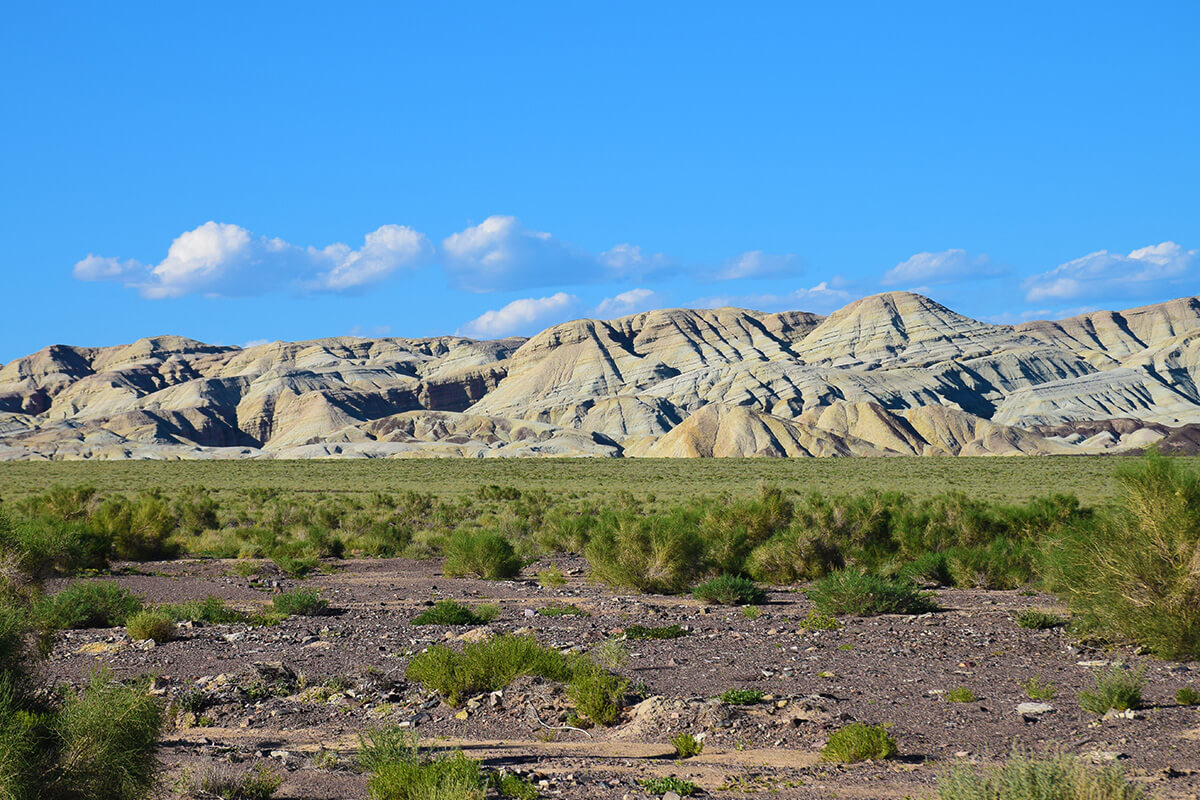
The Aktau Mountains are located in the southeastern part of the Altyn-Emel National Park. This mountain range stands out against the surrounding steppe with its extraordinary shapes and vibrant multi-colored slopes.
The massif has an elongated shape and covers a significant area:
- Length: 30 km from east to west and up to 2 km from north to south.
- Total area: approximately 50 sq. km.
Even from a distance, as you approach the Aktau Mountains, otherworldly landscapes unfold, resembling a set from a science fiction movie. The gorges and multicolored canyons of the massif form an extensive labyrinth. Right at the entrance to the main canyon stands the famous striped mountain shaped like a yurt. There are several of these "yurts" — natural conical formations — throughout Aktau.
The primary color of the mountains is white, which gives the range its name: Aktau (translated from Kazakh as "white mountains"). However, upon closer approach, the mountains are striking in their vibrant colors: the dominant white alternates with shades of blue, red, yellow, and green. These colored strata form striped patterns across the rock faces, creating the unique appearance of this natural monument.


Aktau Chalk Mountains: The Bottom of an Ancient Ocean
The Aktau Mountains are a giant "layer cake" of soft sedimentary rocks, frozen in time within the Ili Basin.
Scientists still debate the true origins of this place. According to one of the versions, these slopes were once the floor of the ancient Tethys Ocean, which long ago filled the entire basin.
While this is just one hypothesis (alongside theories of vast prehistoric lakes), the landscape speaks for itself: walking along the canyon floor feels like diving into the deep sea, with the only difference being that instead of water, you are surrounded by the dry air of the steppe.
Tethys was a Great Ocean that separated the supercontinents of Laurasia and Gondwana during the Mesozoic Era. The modern Caspian and Black Seas, and the now-vanished Aral Sea, are the "grandchildren" of that same mighty ocean.
The foundation of the Aktau Mountains was laid during the Cretaceous Period (145–66 million years ago), which is why these formations are often called the "Chalk Mountains of Aktau." The name of the era itself — Cretaceous (from the Latin creta, meaning "chalk") — is no coincidence. During that time, sea levels were exceptionally high, and warm waters teemed with microscopic organisms with calcareous shells. As they settled on the seafloor, they formed the soft layers we know today as chalk.
In the Aktau Mountains, the total thickness of these deposits reaches 1,200 meters. The colors here serve as markers of different climatic eras:
- Red Layers: Witnesses to the scorched climate of the Paleogene and Neogene periods, when ancient clays were literally "baked" under the intense sun.
- White Layers: The characteristic "chalk" deposits and lacustrine (lake) clays formed under more temperate conditions. These gave the mountains their name — Aktau ("White Mountains").
- Green and Blue Layers: The result of complex chemical processes occurring in bottom sediments in an oxygen-free environment.
The Aktau Mountains are fascinating not only for their colors but also for their "posture": visually, the horizontal axis of the mountains does not align with the horizon. It feels as if the very surface of the earth here was intentionally tilted by several degrees.
From a geological perspective, there is a clear reason for this tilt — the mountains form an anticlinal fold (an upward arch in the Earth's crust). The southern slope of Aktau is steep and sharp due to a tectonic fault that literally "sheared off" the edge of the massif. In contrast, the northern slope is gentle and long, gradually sloping down toward the plain. This causes the entire rock mass to be perceived at an angle relative to the horizon.


Aktautitan and Ancient Flora
The Aktau Mountains are one of the region's largest sites for Cenozoic fauna fossils.
Aktautitan: The "Thunder Beast" of the White Mountains
The region’s crowning scientific achievement is the Aktautitan (Aktautitan hippopotamopus) — a unique prehistoric giant discovered in Kazakhstan in the mid-1990s and named after the mountains themselves. During joint Kazakh-American expeditions, a nearly complete skeleton was unearthed here — a find with no parallels in world science at the time.
Its massive body and stout legs make it look remarkably like a modern hippopotamus; for this reason, the descriptor hippopotamopus — meaning "hippo-footed" — was added to its Latin name. However, while Aktautitan may look like a hippopotamus, the similarity is deceptive. It did not arise from a shared ancestry but because both animals lived in similar environments — near bodies of water and on soft soils, where massive legs were essential to avoid sinking into the mud.
In reality, Aktautitan was not an ancestor of the hippo. It belonged to the extinct family of Brontotheres (from Ancient Greek for "thunder beast" — a name proposed by paleontologist Othniel Charles Marsh in 1873). Based on its skeletal and dental structure, this giant was a member of the order Perissodactyla (odd-toed ungulates), making it a direct relative of modern horses and rhinoceroses.
Other Ancient Inhabitants
In various strata of the mountains — spanning from the Eocene to the Miocene — paleontologists have discovered skeletal fragments of diverse creatures: crocodiles and giant turtles, whose presence confirms that the climate here was once much warmer and more humid; mastodons (distant relatives of elephants) and giant hornless rhinoceroses; as well as deer and antelopes, which appeared in later layers as lakes began to give way to open plains.
Ancient Flora
The Aktau Mountains are not only home to animal fossils but also represent one of Kazakhstan’s rarest sites for ancient flora. Paleobotanical studies have identified the remains of 56 plant species here, including poplar, willow, elm, barberry, and ailanthus. These were the proto-tugai — the ancestors of the tugai (riparian forests) — as well as proto-shiblyak, shrub formations resembling the Mediterranean shiblyak (dense thickets). This flora reflects a stage of gradual aridization (drying) of the climate.
Lake or Ocean?
Although the foundation of the Aktau Mountains was laid by the great Tethys Ocean during the Paleozoic and Mesozoic eras, most paleontological discoveries have been found in the deposits of ancient freshwater lakes from the Cenozoic era. This points to a grand transformation: as the salt waters retreated, a network of freshwater bodies took their place.
It was these lacustrine layers that formed the "upper floors" — the vibrant, multicolored canyons of the Aktau Mountains.


Aktau Geopark
Altyn-Emel National Park is a unique natural region that is rightfully called a geopark. Here, the grand geological history of the Earth is vividly revealed — from the formation of rocks and mineral deposits to the emergence of ancient plants and animals. In terms of the richness of its geological formations, Altyn-Emel surpasses many global reserves that hold official UNESCO Global Geopark status.
The park’s territory is a giant geological museum. Within its landscapes, one can trace the long history of the region’s development — from the moment the first islands emerged in an ancient ocean to the formation of today’s desert mountains with their unique flora and fauna.
The primary "exhibits" of this museum are three mountain ranges:
- Aktau Mountains: These preserve the remains of ancient crocodiles, turtles, and giant mammals — such as the unique Aktautitan — within their multicolored layers.
- Katutau Mountains: A testament to past volcanic activity. Here, frozen lava flows and specific weathering forms have created a bizarre, otherworldly landscape.
- Kalkan Mountains: Ancient folded mountains, at the foot of which the famous Singing Dune phenomenon is born.
How to Get to the Aktau Mountains
The Aktau Mountains are the longest and most remote route in the national park, so the trip requires some planning. To ensure your visit is comfortable and follows all regulations — please review the detailed instructions below:
- Self-Drive Trip to the Singing Dune and the Aktau Mountains — the optimal travel plan, essential route information, road conditions, and time estimates.
- How to Buy a Permit — up-to-date information on park opening hours, entry rules, and permit costs.